Posts

Black Ice, Truck on My Tail, Road My Ancestors Walked

I pushed on through the mountains, the Chevy Lumina taking the curves with surprising accuracy. Snow lay along the roads as I watched for black ice on the interstate.

I had hit black ice before, when I was about 20. I exited Atlanta’s I-285 at Doraville, heading home from a concert in Marietta. About 20 feet onto the circular ramp, the car spun out of control. Using what I had learned in driver’s ed a few years earlier, I did not fight it. I turned into the spin and prayed until the car came to rest, facing oncoming traffic.

I was blessed that it was about 2 a.m. and no one was exiting behind me. I let the car slip backward off the ice, turned around, and drove on, feeling as if I had just walked out of the scariest scene in a horror film.
Now, crossing that same kind of country, I thought of my ancestors making their way west through these mountains without the advantages of modern travel. I am sure my heart pounded much as theirs did when a bear came close, or when they tried to avoid a hunting party in the woods. Time and technology do not change the basics of the human condition. We still face fears, some imagined, some real.

Then I looked in the rearview mirror. Headlights seemed to be on top of me. My heart raced as Jim and Jesse’s “Diesel on My Tail,” a song I once recorded, began to feel like prophecy. I hugged the curves, trying to stay ahead, but I was not going fast enough in the dark, icy conditions to suit the trucker.

I moved into the other lane, even though the ice looked worse there. In the mirror, no matter where I went, the truck stayed behind me. Maybe it was only the turning roads. I kept pushing, hoping to reach the flatlands.
Finally, as we cleared the Appalachians, the truck passed and sped off into the night.

I continued home from North Carolina, more relaxed now that the ice was behind me. My greatest concern was keeping my mind occupied and my eyes open.

What makes such moments worthwhile is that they remind us the world is beautiful and filled with God’s creations, and that we can still find ourselves with a racing heart and a mind given over to fear. How we react, knowing God is with us in everything, shows whether we can keep walking the path our ancestors walked: one step at a time, into the unknown.

Read more of Randall’s writings in his books available in the Store.

Brothers Divided: A Frontier Family’s Revolution Sacrifice

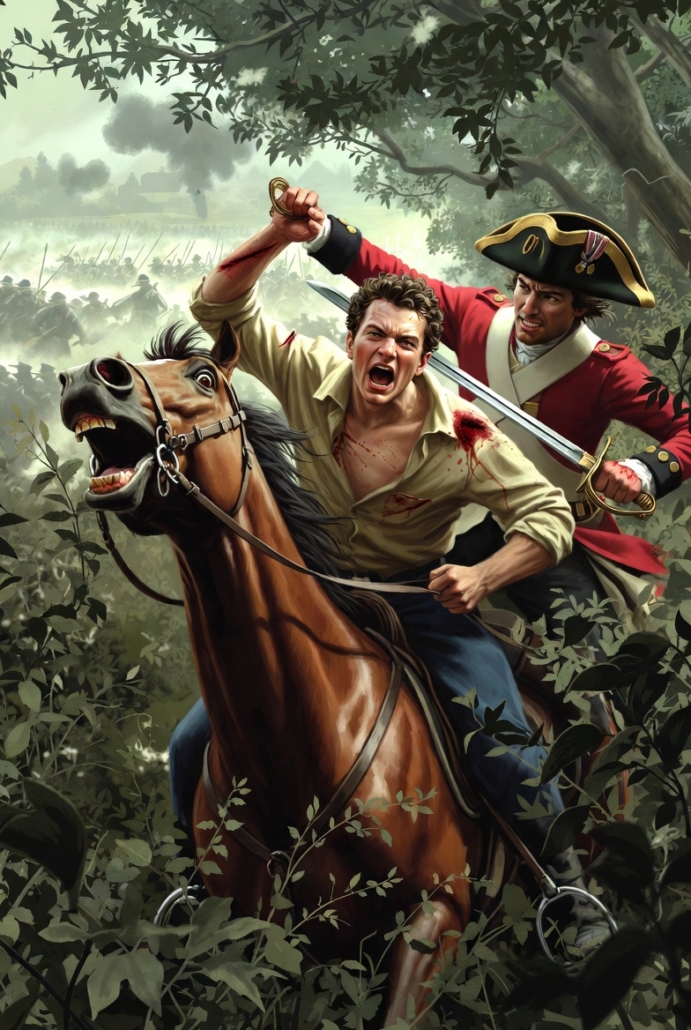
A Depiction of Joshua Moses engagement at capture.

Imagine fleeing on horseback through the thick South Carolina underbrush, only to feel the sting of a British dragoon’s sword slashing your arm as you deflect a blow meant for your head. This was the harrowing fate of Joshua Moses in 1781, a North Carolina militiaman captured while visiting kin near the Wateree River. Wounded four times—a deep head cut, an arm laceration, a shoulder pierce, and a minor gash—he was bound and marched toward the chaos of battle. But Joshua’s story, like his family’s, reflects the deeper tensions of a war that pitted neighbor against neighbor and brother against the call to arms.

Life on the colonial frontier demanded every hand to tend farms and protect families. When whispers of rebellion against England rippled through the land in the 1770s, they ignited fierce divisions. In Anson County, North Carolina—home to the Moses clan—Loyalists (Tories) were a formidable force. Continental General Nathanael Greene estimated in 1781 that up to half of North Carolinians were Tories, dominating about half the state’s counties, including backcountry areas like Anson. Petitions from the era show roughly 227 Anson residents pledging loyalty to the Crown, compared to about 355 who had earlier protested colonial grievances as Regulators—a movement that often fed into Patriot support. This near-even split made open rebellion risky; many families chose neutrality to survive raids and reprisals.

John Moses Sr. and his wife, Jane, had settled in Anson County by the 1760s, raising likely four sons—John Jr., Joshua, Samuel, and Robert—and two daughters to adulthood before the war escalated. John Sr. likely died sometime after 1763, leaving Jane a widow in a turbulent time. As conflict engulfed the South, the pull to fight tugged at the brothers’ hearts, but someone had to keep the home fires burning amid Loyalist threats. Samuel stayed behind, farming and safeguarding the family stead, while Robert also remained neutral, later settling near the Wateree. Joshua and John Jr., however, answered the call.

John Jr., the eldest, had migrated south to South Carolina by the early 1780s, near the Wateree River. This was the heart of the brutal Southern Campaign, where British forces occupied much of the state, and local militias waged guerrilla warfare alongside Continentals under Greene. As a private in the South Carolina militia, John served 110 days in 1781 and 1782—short bursts of duty that might have included sieges like Ninety-Six or Augusta, or clashes with Loyalist partisans. His service, documented in state audited accounts, earned him a modest indent for pay, though no federal pension followed.

Meanwhile, back in Anson, Joshua (1748–1836) volunteered under Captain Williams in Colonel Thomas Wade’s regiment (DAR Ancestor #A082368). His unit patrolled Drowning Creek near the NC-SC border, scouting for Loyalists. In one skirmish on Brown’s Creek, they routed a Tory band without fatalities—a gritty echo of the Carolinas’ internal strife. After seven months, Joshua’s company received parole, sending him home on call.

Fate wasn’t done with him. Venturing to the Wateree—likely to check on John Jr. and Robert—Joshua was ambushed alone by dragoons. Captured and wounded, he was hauled toward Eutaw Springs (September 8, 1781), guarded amid the battle’s roar before transfer to Charleston’s crowded provost prison and then James Island. Nine months of harsh captivity followed. In a daring escape, Joshua and comrades paddled an old pirogue for three starving days, reaching Greene’s forces on the Ashley River. Greene granted rations and leave, with the war winding down after Yorktown’s surrender in October 1781. Credited with 16 months total (including imprisonment), Joshua later drew a $53.33 annual pension from 1831. Post-war, the brothers scattered into the wilderness they helped secure: Joshua to Whitley County, Kentucky, around 1813; Samuel to Monroe County, Tennessee; John Jr. and Robert to Jasper County, Georgia. Separated by miles, they carried shared memories of a divided era, passing tales of sacrifice down generations.

Let us never forget that farmers and frontiersmen bled to forge this nation. Patriots Joshua and John Moses Jr. are the uncles of this columnist, who descends from their brother Samuel of Monroe County, Tennessee who helped keep the home fires burning amidst the Loyalist threats.

The descendants of Samuel are included in Randall’s book A Mountain Pearl : Appalachian Reminscing and Recipes