

Ordinary Heroes: The Remarkable Founders of America

There are many ways to celebrate the founding of our country. Two hundred and fifty years ago, 56 men gathered to debate how the 13 colonies would move forward as a new nation. These delegates came from every colony, representing a remarkable cross-section of American life. Some were wealthy and well-established in their professions, while others were ordinary tradesmen and farmers. That, in many ways, was what America’s early years were all about. It wasn’t about nobility or inherited privilege—it was about ordinary people having a voice in shaping their future whether they were in that room or serving near their home.

One such man was frontier farmer Thomas Arnett Sr. (1740–1808) of Augusta County, Virginia. Soon after the battles of Lexington and Concord, he volunteered as a private in Captain Pryor’s Militia Company. In addition to his military service, he contributed 300 pounds of flour from his modest farm to support the Continental Army. From 1775 until the war’s end, Arnett found multiple ways to have his say in the struggle for independence.

The spirit of resistance first took root in Boston, where tradesmen and ordinary citizens publicly objected to the Crown’s oppressive taxes, beginning with the Stamp Act. The Sons of Liberty emerged from that early resistance, spreading the cause of liberty across the colonies from the shadow of Boston’s Liberty Tree. Declaration signer Samuel Adams was a founding member of the group. Though he struggled financially as a businessman—he even lost the family brewery—his passion for creating a free nation proved far more valuable. Through his tireless efforts, Adams helped lay the groundwork for generations to come.

Another signer, George Walton of Georgia, rose from humble beginnings. Orphaned young and raised by an uncle, he was apprenticed to a carpenter. Largely self-educated, he became a lawyer and eventually served as governor of Georgia.

Signer Abraham Clark of New Jersey showed little interest in personal wealth. As an attorney, he devoted much of his practice to helping ordinary people who could not afford legal representation. Contemporaries described him as “limited in his circumstances, moderate in his desires, and unambitious of wealth.”

It was John Adams of Massachusetts who famously observed that about one-third of the population supported the Revolution, one-third remained Loyalist, and one-third stayed neutral. Among the founders who shaped the nation’s spirit, Adams stands out as one of the most influential. He was often unpopular among his fellow delegates, largely because of his relentless push for independence. It was Adams who helped steer the young Thomas Jefferson of Virginia into the role of primary author on the committee tasked with drafting the colonies’ grievances against King George III.

That committee included Adams, Jefferson, Benjamin Franklin of Pennsylvania, Roger Sherman of Connecticut, and Robert R. Livingston of New York. It was Virginia’s Richard Henry Lee who first advanced the cause with his resolution declaring the colonies “free and independent states” in June 1776. The committee was formed in response, and by July they had prepared a draft for debate.
In his original draft, Jefferson included a powerful condemnation of the slave trade and slavery itself. Unfortunately, that passage was struck out after objections from delegates in both the northern and southern colonies. While the focus remained on achieving independence, the ideal of freedom for all had been planted—though it would take nearly another century and the lives of hundreds of thousands of soldiers before that ideal began to be realized.

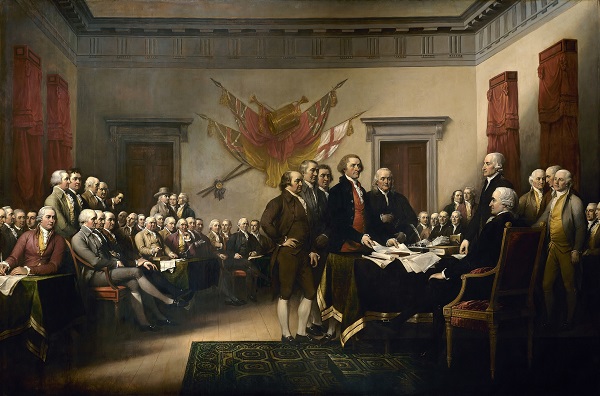
The Congress approved the final text on July 4, 1776—the date we celebrate as our nation’s founding. The actual signing of the engrossed document took place primarily on August 2, 1776, a moment famously reflected in John Trumbull’s iconic 1818–1819 painting of the June 28th presentation by the committee.

Among the signers, Roger Sherman of Connecticut stands in a class by himself. A self-made man who began his working life as a cobbler, Sherman is the only delegate to sign all four of the nation’s foundational documents: the Continental Association; the Declaration of Independence, the Articles of Confederation, the U.S. Constitution, and he also served on the committee that helped draft the Bill of Rights. A version of the Bill of Rights in his handwriting still exists today.

These men—and the countless ordinary citizens who supported them—created something unprecedented in world history. In an age dominated by monarchies, they offered the radical idea that ordinary people could govern themselves. They gave the world a new hope for freedom and self-determination. Two hundred and fifty years later, that experiment continues. Whether by attending a Revolutionary War reenactment, participating in a grave marking ceremony for one of these patriots, joining a local Independence Day celebration, or watching a parade, there are many meaningful ways to honor their extraordinary legacy this year. If that isn’t worth celebrating, I don’t know what is.

The columnist is related to Thomas Arnett Sr., paternal 6th Great Grandfather; and he is related to 48 signers of the Declaration including most of those mentioned above.

Read other writings from Randall Franks in his books: Store

I wonder where does the time go?

Each day I find myself rising and trying to find my way through a long list of tasks that need my attention. Sometimes I wonder why the list does not shorten, but it continues to remain steady. The list of course contains many of the same ones you have on yours—washing, cleaning, mowing, trimming, and a myriad of daily tasks: cooking, shopping, errands and other routines. Those are always on the list.

Then I decide to add to the list constantly for my career—more writing, more music, more personal appearances. With each choice the list grows. Volunteering and public service makes the list also, adding additional hours and tasks to be done.
I was talking with someone this week, sharing how since April I have been trying to get a chance to plow my garden spot and get something planted, but between the to-do list and the rain, it’s just not come to pass.
That’s what got me wondering: Where does the time go?
It’s a question we all mutter when weeks, months or even years suddenly slip away unnoticed—a rhetorical sigh that captures surprise, nostalgia and a touch of regret about how fast life moves. It’s not asking for a literal answer (time doesn’t “go” anywhere physical); it’s an emotional outburst about the fleeting nature of our days, a modern cousin to the ancient Latin tempus fugit—“time flees.”
Science offers some comfort for why it feels this way. As we age, each year becomes a smaller slice of our total life so far. A year that felt endless to a five-year-old (20 percent of everything they’d ever known) is only two percent by age fifty. That’s the proportional theory of time perception, first laid out by philosopher Paul Janet in 1897. On top of that, our brains collect fewer fresh “novel frames”—distinct memories—once routines set in. The same commute, the same chores, the same deadlines blur together, so entire seasons vanish in hindsight. Even our mental “frame rate” slows; we simply take in fewer snapshots per second, making days race by like a video played at half speed.
I know that each day I aim at completing a number of tasks before I turn around and find it’s time to hit the hay—and then, in eight hours, I start again. That old idiom itself carries a quiet echo of simpler times. “Hit the hay” dates back to the early 19th century, when many mattresses were literally sacks stuffed with hay or straw. “Hitting the hay” meant flopping down onto that scratchy, farm-style bed at the end of a long day—the same humble origin behind its cousin phrase, “hit the sack.”
So here we are, lists unchanged, garden still waiting, another sunrise already on the horizon. The real wonder isn’t that time vanishes; it’s how little of it we notice while we’re living it. Maybe the question isn’t “Where does the time go?” but what we choose to do with the small, steady portion that’s still right here in front of us.
Find more of Randall’s writings in his books at the Store.

Creating Positive Momentum: Small Steps, Lasting Change

Sometimes we work toward making positive momentum in our lives. We’ve all been there. These steps can take many forms, and they rarely arrive with fanfare or a dramatic soundtrack. More often they begin quietly — a decision, a small action, or simply the recognition that something needs to shift.

For some, momentum looks like a career move. I haven’t had one of those in many years, at least not in the traditional sense. Public service in political office might qualify, but even then the distinction matters. At the state or national level, it can become a genuine career with resources and staff. At the local level, however, there’s very little money involved, so I’ve never viewed it that way. It’s service, not a stepping stone.

For others, momentum takes the shape of an entrepreneurial adventure — launching a product, starting a business, or bringing an idea into the world. In my case, that has meant publishing my new book, Frankly Speaking: Thoughts on This and That. After years of notes, reflections, and scattered drafts, seeing it finally take shape felt like building real forward energy.

Sometimes the push is more domestic. It might be tackling that long-undone project around the house — the one that has quietly become part of the scenery. For me, it’s the growing piles that gather dust: materials waiting to be organized into scrapbooks, old mail that needs shredding, work papers that still require filing, and the miscellaneous accumulation of years that somehow never quite gets addressed. Each time I chip away at one small corner of it, I feel the satisfying click of momentum.

And then there are the deeply personal changes — the ones that happen inside our own skin. Losing weight. Establishing a better exercise routine. Stopping an annoying habit. Personally, I don’t think I need to lose weight, though I know I can always improve my life with more consistent exercise (which tends to take care of the weight question anyway). As for annoying habits, I believe I’ve cast most of them into the dust bin of the past. I pray regularly to keep them there, and so far that discipline has served me well.

The question that lingers for all of us is this: What is the best approach to create and maintain momentum once we decide to move forward?

From what I’ve observed in my own life and in the lives of people around me, momentum rarely comes from grand, sweeping resolutions. It comes from something steadier and more humble: choosing a direction and then protecting the small, daily actions that keep you facing that way.

First, clarity matters. It helps to name the thing you actually want — not the vague “I should get organized” or “I should exercise more,” but something specific enough to act on. “I will spend fifteen minutes each morning sorting one pile of papers.” “I will walk three times this week.” “I will write one page of the book every weekday.” Specificity turns intention into a plan.

Second, start ridiculously small. The bigger the leap we try to make, the more likely we are to stall. Tiny steps build confidence and reduce the friction that kills momentum before it begins. A single drawer cleaned out. One paragraph written. One evening without the old habit. These micro-victories accumulate and, more importantly, they train us to trust ourselves again.

Third, protect the chain. Momentum loves consistency more than intensity. Missing one day is usually harmless; missing two or three in a row is where the slide begins. Simple tools help here — a visible calendar where you mark each successful day, a friend you check in with, or even a quiet evening reflection where you ask, “Did I move forward today, even a little?”

Fourth, celebrate honestly but lightly. Acknowledge the progress without turning it into a production. A quiet “That felt good” or a small reward that doesn’t undo the effort (a favorite tea instead of a celebratory dessert, perhaps) keeps the emotional energy positive without creating new problems.

Finally, stay compassionate with yourself when progress slows. Life has a way of interrupting even the best-laid plans. The difference between people who maintain long-term momentum and those who don’t often isn’t talent or willpower — it’s the willingness to begin again without self-scolding. Dust yourself off, remember why you started, and take the next small step.

Whether your current momentum is aimed at a career shift, a creative project like a book, clearing out the physical or mental clutter at home, or simply becoming a healthier version of yourself, the principle remains the same: direction plus small, consistent action eventually creates real movement.

The piles in my study are smaller than they were last month. Pages of the next writing project are slowly accumulating. And each small win reminds me that positive momentum isn’t about transforming overnight. It’s about refusing to stay stuck — and choosing, day after day, to move forward just a little more than yesterday.

What about you? What small step could you take this week that would create a bit of positive momentum in your own life? Sometimes the best columns are the ones that leave us both thinking and acting.

Read more of Randall’s work in his books in the Store or on Amazon: https://www.amazon.com/stores/Randall-Franks/author/B00K9XIDN4

Laughter in the Pews: Church Chuckles

One of my readers kindly suggested I share a bit of comedy in this column to lift the spirits of folks back home. Some of the best laughs I know come from church and the honest wisdom of young’uns.

Take my nephew, for instance. A few years back he asked if he had a guardian angel.

Sure you do,” I told him.

Your guardian angel is always with you.”

Does he eat with me?” he asked.

Sure.”

Does he sleep with me?”

Sure.”

Well that must have been who kicked me out of bed last night,” he said.

Kids have a way of cutting straight to the point, and so do a lot of the old church stories that still make the rounds. Like the one an older fellow told me about where radio was invented:

In the Garden of Eden,” he said.

“What?”

God took Adam’s rib and made the first loudspeaker.”

Then there’s that little-known fact about Noah’s Ark. Seems there were three camels on board. The first was the camel many people swallow while straining at a gnat. The second was the camel whose back was broken by the last straw. And the third was the one that shall pass through the eye of a needle before a rich man enters the kingdom of Heaven.

Of course, prayer doesn’t always bring exactly what we expect. Farmer Jud and his wife Jeweldine, a childless couple, prayed long and hard for a baby. Their answer came in the form of triplets. When the preacher congratulated them on their answered prayer, Jud just shook his head and said, “Yep, but I never prayed for a bumper crop.

Another woman, tired of searching for the right man, finally prayed, “Lord, I’m not asking for anything for myself, but please send Mother a son-in-law.”

And then there’s the young fellow who was asked by his prospective father-in-law, “Can you support my daughter in the manner she’s accustomed to?

The boy thought for a second and answered, “She ain’t gonna move, is she?

I’ve always heard that bread cast upon the waters returns to you. It may be true for bread, but I’ve noticed all the bread we keep sending overseas sure doesn’t come back the same way.

Laughter has always been important in our family, even though our people tend to be stoic by nature. That stoic streak runs strong in me too. Folks often ask why I don’t smile more. Sometimes I tell them, “I’m smiling on the inside.”

Because of that, the moments of real joy and laughter mean even more to me. May laughter fill your days, friends. After all, God must have a sense of humor—otherwise He would have never made someone quite like us, would He?

Catch more of Randall’s Comedy on Itunes in Comedy Down Home: https://music.apple.com/us/album/comedy-down-home/1733917822

Read his books also for an occasional laugh, check out our store.