Have you got something stuck in your craw?

You’ve probably heard the expression “They have something stuck in their craw.” It’s one of those old sayings that essentially means someone is mad or upset about something.

There’s not a day that goes by when such an occurrence can’t seep into your being and take over your thinking. It might be a passing statement uttered by a relative or friend, an encounter with a perfect stranger that catches you the wrong way, or even your closest people—wife, husband, mom, dad, children—simply getting on your nerves. These little irritations can accumulate in your craw like crumbs over time until eventually you just have to get them out.

What is a craw, anyway? It’s the pouch in a bird where food is stored before reaching the stomach. How this comparison became part of the human lexicon, I’m not sure, but the phrase has been with us since the days of King Henry VIII.

Life, with its many trials and daily experiences, can be either a path of pleasantness or miles of misery—or, of course, a mix of both. As the old Scottish folk song goes, “You take the high road and I’ll take the low road, and I’ll be in Scotland afore ye…”

With the exception of unforeseen circumstances such as accidents, illness, and unexpected losses, we largely sit in the driver’s seat. We turn the wheel, press the gas, hit the brake, and decide what gear we’re traveling in. Even when something intervenes, we still have a chance to choose how we will react to it.

I learned long ago that fretting over encounters with people who aren’t a regular part of your life is truly a waste of energy and time. Letting those moments stick in your craw is fruitless—like a barren tree. It’s the moments among our closest loved ones that most often plague the mind and keep the wheels spinning.

Recently one of those hit me and kept my thoughts turning for hours whenever my mind wasn’t occupied with other tasks. Sometimes, no matter how much something sticks with you, you simply have to find a way to let it go. I’ll be the first to admit that is one of the hardest things to do—our loved ones know exactly how to push our buttons.

Life is hard enough without letting flippant utterances steal our time, energy, and focus from what can fill our lives with joy, happiness, and hope.

Learn to let go, take the high road, and find the path to pleasantness.

Read more Randall Franks writings in his books found in the Store.

Frozen Eggs and Hard Lessons on the Trail

We crawled out of the tent and started a fire. The goals were simple: warm up and cook some breakfast. The chattering of our teeth, despite the long johns and layers of clothes on top of them, wasn’t helping as we tried to endure the freezing cold of the mountains around us.

We broke the ice in the bucket and poured enough water to fill a pan for grits. When the frying pan was hot, we added frozen bacon. We had planned on scrambled eggs, but when we cracked the shells, all we found inside were egg ice cubes. So we simply dropped those into the skillet.

When a bunch of Boy Scouts hit the trail, it’s amazing what the food sometimes looks like after we cook it. Most of the time it’s edible, but the appearance could sometimes sway one’s appetite. That morning we started out feeling as if we were already in a freezer. I can only remember one other time being quite so cold—on a camping trip in the northern part of the U.S.

After breakfast we cleaned up, broke camp, and moved on. Two adult leaders and about a dozen scouts with backpacks headed toward our rendezvous point.

Those monthly camping trips were about far more than getting from one campsite to the next. Their real purpose was to strengthen our survival skills and put into practice what we were learning as we worked through various merit badges. Our leaders were good fathers and great teachers who invested in us. Our lack of skills felt like a constant uphill battle, yet as we climbed the ranks we grew more proficient and eventually could advise and coach those coming up behind us. My late father was one of those adult leaders. He always made the best effort to pass on his skills.

Of course, we still dealt with the same dynamics we faced in everyday life. There were the cool guys and the not-so-cool ones, and we sometimes found our share of hazing among the ranks. I was never one of the cool guys, but I excelled at earning merit badges and rose quickly through the ranks. I learned fast, and after the initial hazing the incidents became fewer and further between.

One year at summer camp, however, the bullying grew heavy. It was one of the few times in my life that I truly lost my cool. Pushed so far that all I could do was lash out, I picked up a three-inch-thick wooden tent pole about six feet long and started swinging it at the boys who were harassing me. In retrospect it was stupid and could have ended very badly. Thankfully I don’t remember landing any blows. Had I connected, I could have killed someone or broken a bone. The one thing it accomplished was that they saw I was no longer going to take it, and they left me alone after that.

I learned a valuable lesson that day about dealing with anger in the face of bullying—a lesson that has stayed with me the rest of my life. I am a much better person for the experience. The cold mornings, the hard climbs, and even the painful moments all taught the same truth: when life sends you an opportunity, seize the lessons it offers and build skills that will help you again and again.

Read more of Randall’s writings in his books in our Store.

Getting Things Done That You Really Don’t Enjoy

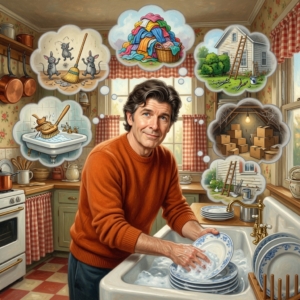
Life is filled with tasks that, as time goes on, we can feel increasingly annoyed by.
Who loves doing the daily household chores—cooking, washing dishes, sweeping the floor—or the weekly ones—washing clothes, cleaning the bathroom, working in the yard?

As the world keeps spinning and our days begin to pile up, sometimes you just look at these tasks and say, “No, not again.” It might seem self-defeating. You know it’s simply an exclamation in vain, because the work must be done and there’s no one else to do it. When I walk outside, I see the pressure washing that’s required, the shingle that needs fixing, the painting that is needed, the concrete repairs that should be tackled, the bushes that need to be cut—and the list continues.

I climb the stairs into the attic, and waiting for me is more cleaning, straightening, and sorting.


As I walk through the house, the dust bunnies play on the floor like they have the run of the place, the laundry needs folding, the bathroom needs a scrub, and my, how the piles of work seem to be gaining on my height.

My brother recently decided he was done. He has sold his home, and with it go 90 percent of these tasks. He will eventually gain others to replace them, but for now he sees the light at the end of the tunnel.

I, however, am not that brave. I like the consistency of place and everything in its place. Home is where I lay my head at night. It’s where I do life. One day someone else will make this space theirs, but for now—and hopefully, the Lord’s will—it is where I will pass a few more decades.

So, as the generations before me, I must buck up and just do it. Whatever it may be, it’s not as bad as it seems, and though the doldrums of repeated activity may creep into my psyche, I must persevere.
And so must you. These things we do daily seem unimportant in the scheme of things, but for those of you sharing life with someone else—spouse or children—it’s these shared experiences of doing the tasks that sometimes become the basis of memories.

Doing things together is what stands out in my thoughts of growing up. We did so much, but as Mother would say, “Many hands make the burden lighter.” I do miss the many hands. The tasks I was assigned, always trying to get them perfect, then followed by showing them to Mom or Dad—and the praise, or sometimes the lesson, that followed—stuck with me and helped shape the man I am.

That’s one of the things missing today. I tend to find my own lessons, but it’s hard to praise yourself. You can, and I do, yet the feeling of self-satisfaction from a job well done on daily or weekly tasks seems hollow sometimes. The special projects stick a while, but it’s hard to get excited over a well-cleaned toilet.

Perhaps the best encouragement for the effort comes from God’s “attaboy” through His Word: “His lord said unto him, Well done, thou good and faithful servant: thou hast been faithful over a few things, I will make thee ruler over many things: enter thou into the joy of thy lord.” — Matthew 25:21 (KJV)

So stop fretting the little things. Just do them, move on, and find the tasks that excite and uplift your soul. The sooner these are finished, the more time you can spend doing those.

Read more of Randall’s writing in his books found in our store.