

Posts

The Needle Is Stuck, Give It a Bump

I have watched numerous family members and friends endure the ups and downs of chronic illness, struggling with tasks they once performed with ease.

When I was a child volunteering in a local nursing home, I met a woman of about eighty named Georgia McMahan. Georgia suffered many of the same ailments as her fellow residents, yet you would never have known it. From the moment you saw her, the smile that beamed from her face lifted your spirits and gave you a sense of gladness that could carry you through any task. Added to that smile were words of encouragement, concern, and hope that seemed to pour from her very being.

While many of the people my efforts brought me into contact with appeared mired in a ditch of despair, Georgia shone as if she were standing on a mountaintop in a field of wildflowers.

Sometimes, when I hear people recount the same struggles again and again, I picture the spinning turntable of my youth with a 33⅓ rpm record going round and round. I remember how, when a particular tune had been played too often or had been accidentally scratched, the needle would sometimes stick, repeating the same musical phrase over and over. It took me getting up, walking to the record player, and gently nudging the tonearm to lift the needle out of that deep, dark vinyl groove so the music could continue down the road.

Like that needle, it is easy to get stuck in the scratches and worn-out grooves of our own lives and find it hard to move forward. We spin endlessly in the same spot, repeating the same actions and saying the same things, only to discover we are doing it all over again. Sometimes it takes someone to give us a gentle shove so we can realize that just a millimeter farther along our path we may find something better—and even if we don’t, we are better for having tried.

Looking back now, I see Georgia as the person God placed in that nursing home to nudge those around her and give them a chance to climb out of a groove that was wearing on them and on everyone who could hear their song.

Are you serving as a catalyst to help yourself and others over the hump and onto a smoother path? If not, why not?

The path Georgia showed me as a child still gives life a better spin than any other I have seen. I hope I can always choose the spin that lets me feel as though I am standing on the mountain in a field of wildflowers.

Read more from Randall in his books in our Store.
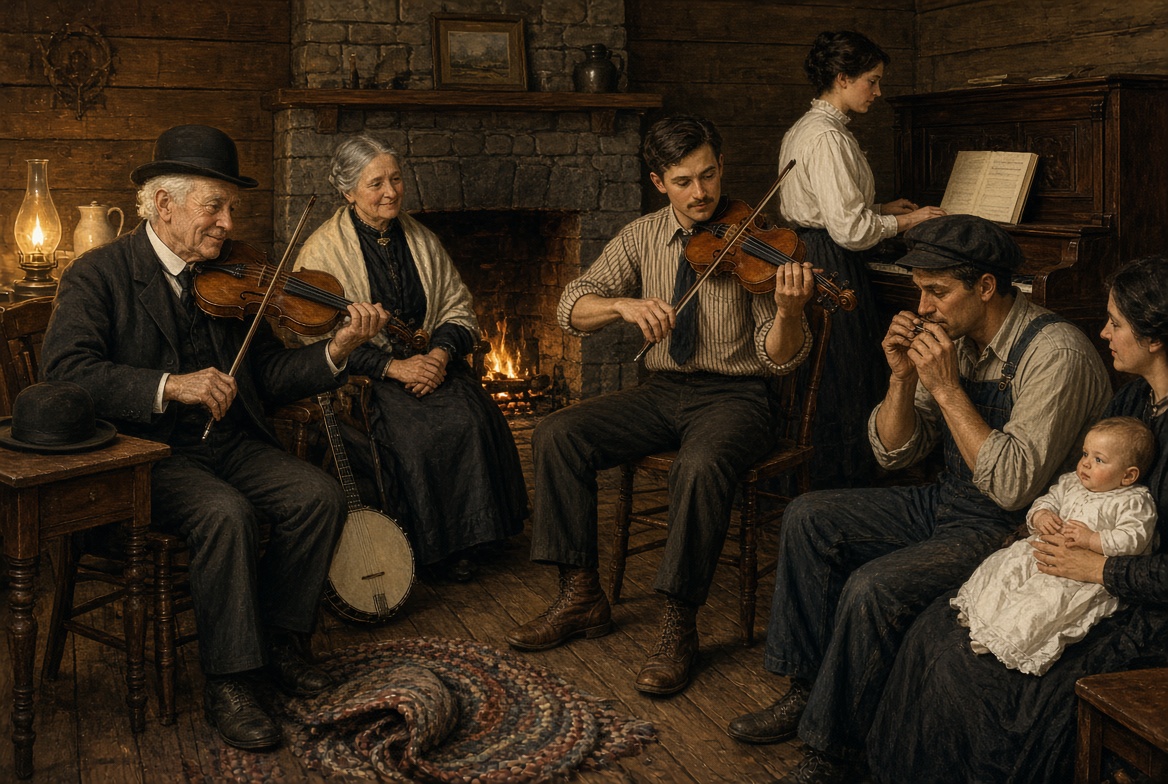
A Farmhouse Tale: A Fiddle and a Fireplace

I don’t know much about my Grandpa Harve’s childhood, although I am told his tales of life on the Tennessee River rivaled Mark Twain’s Huckleberry Finn.

When my dad was a boy, Harve gathered the children around the fireplace and, before bed, told a story of an orphaned boy named A.J. (his real initials), filled with the intrigue of riverboat gamblers and the dangers of riding the rapids on a handmade raft.

By then Harve had grown into what my late cousin Reece Franks called a demanding man. After Reece came in from the general store, Harve often sent him back out to tend the horse and buggy while the older men sat and reminisced.

For some reason, as Harve became a man, the waters of time brought him to Catoosa County, Ga., where he courted a young girl named Emily Jane Bandy—Grandma Emmer to the family. Already a talented fiddler, he brought the fiddle along when he courted. Grandma Emmer often thought he spent more time a fiddlin’ than he did a courtin’. He eventually won her heart, and the couple settled into a life of farming and raising children.

He shared that love of music with several of his children: Tom learned the fiddle, Henry the banjo, Ethel the piano, Jesse the harmonica and the jaw harp, and another son the guitar. As the sun lowered itself behind the hills, the clan would often gather in the parlor after supper and play a few tunes like “Turkey in the Straw,” “Leather Britches,” and “Camptown Races.”

Lester and Griff would roll back the rug, and although she’d probably not admit it the next Sunday at the Baptist church, Emmer and Harve danced a jig or two.

Harve had already passed his love of music along when a farming accident injured his left hand and left him unable to play. That loss likely pained him deep in his soul. Henry’s death later took the sound of the frailing banjo from the group, and as the children married, they carried the music with them.

As the grandchildren came buzzing around, I know he would have given anything to pick up his old black fiddle and play them a tune, but instead Harve entertained them with stories of his youth making his way into adulthood in the Reconstruction-era South.

I wish some of them had written the stories down, but alas, they are lost to time, and even the memory that those stories existed is nearly gone.

It was from my great-uncle Tom, who made his home in Gordon County’s Sugar Valley, that I first heard the fiddle played up close. He played some of the same licks his father had played before him. While Grandpa Harve was not there, I could imagine him sitting at the fireplace, his old black fiddle in hand, playing while his great-grandchildren gathered around him.

While many take their musical cues from the pop icons who parade across the Grammy stage, I still draw strength from family roots that run deep in Appalachian soil.

Find more of Randall’s writings at our Store
