

Adam Sherrill’s Ride: From King’s Mountain to Boyd’s Creek
In the chill December of 1780, in the midst of a three-pronged attack against the British-aligned Cherokees, Adam Sherrill’s horse suddenly stumbled on the frozen ground near Boyd’s Creek. The rider was thrown hard amid a 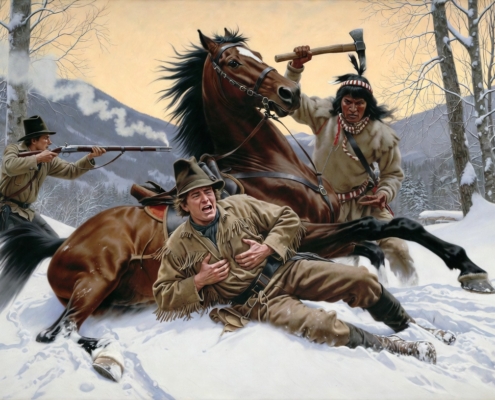 sharp engagement with a Cherokee war party. Pain exploded through his chest as several ribs snapped. Before he could rise, a Cherokee warrior sprang upon him, tomahawk raised for the kill. In that frozen instant, a ball from a comrade’s rifle found its mark. The attacker fell. Adam, gasping, was pulled to safety by his fellow Overmountain Men. The wound would heal, but the memory of that narrow escape—and the hard service that preceded it—would stay with him for the rest of his long life.
Lying on the rough pallet as his ribs knit together in the weeks that followed, Adam Sherrill had time to think. Time to let his mind travel back across the mountains to the journey that had brought him and his family to this hard-won victory—and forward with worry about what lay ahead for those still in the field.
The pain in his side was sharp, yet it paled beside the fire of remembrance and the ache of concern. For Adam had marched not alone, but shoulder to shoulder with his brothers George and Samuel Jr., alongside their father Samuel Wilson Sherrill Sr., and with his brother-in-law Colonel John Sevier in one of the most remarkable campaigns of the Revolutionary War.
The Journey to King’s Mountain
By 1780, Adam Sherrill, born in 1758 on the Yadkin River country of North Carolina, had already put down roots in the Watauga settlements of what would become Washington County, Tennessee. Like his brother George, he had signed the Watauga Petition in 1776, declaring the mountain people’s desire for order and protection. His brother Samuel Jr. stood with them as well. In late September of that fateful year, the brothers—Adam, George, and Samuel Jr.—along with their father, rendezvoused with Colonel John Sevier’s regiment (their brother-in-law through sister Catherine “Bonny Kate” Sherrill) at Sycamore Shoals in Carter County. There, amid the crisp autumn air and the gathering of rugged frontier riflemen, the Overmountain Men prepared to cross the Blue Ridge. The family marched as a unit of resolve. The march itself was legendary: steep mountain trails, cold rains, dwindling rations, and the knowledge that they had left their own families exposed to Indian raids. Yet they pressed on, linking with other North Carolina militia before descending on King’s Mountain on October 7. There, on that rocky knob in South Carolina, the Overmountain Men unleashed a fierce, close-quarters battle. Adam, George, Samuel Jr., and their father fought in the thick of it under Sevier as Ferguson’s command disintegrated. When the smoke cleared, Ferguson lay dead, more than 700 of his men were captured or killed, and the tide of the Southern Campaign had turned. The victory at King’s Mountain would later be called the “turning point” that led to Yorktown. For the Sherrill brothers and their father, it was simply the day they stood with kin and neighbors to help save the frontier. After the battle, they marched the prisoners up to near Gilbert’s Town in North Carolina, then on to Morganton in Burke County, before returning home. These were just a couple of the many hard engagements fought to carve out the frontier they would call home.
Return to Boyd’s Creek, Recovery, and Concern
As Adam’s ribs slowly mended after Boyd’s Creek, he could take satisfaction in the broader campaign that secured the western settlements. Yet a fresh worry gnawed at him. Still sidelined by his injuries, he could not join the continued march south with George, his brother-in-law John Sevier, and the other friends and family who pressed onward. Reinforced by Virginia troops under Colonel Arthur Campbell, they crossed the Tennessee River toward Hiwassee, destroying Cherokee towns in a punishing expedition that lasted into the new year. Adam’s concern for their safety weighed heavily during his recovery—another chapter in the family’s shared sacrifice on the volatile frontier.
Closing Reflection
Adam Sherrill would go on to marry his second wife Rebecca Kilgore in Washington County in 1789 (daughter of one of the five Kilgores of Kings Mountain), raise a family, and eventually settle at the Head of Sequatchie (Gravelly Spur area) in what became Cumberland County, Tennessee. His brother George would later recount their shared service in a pension application, preserving the memory of the Carter County rendezvous, the march to King’s Mountain, and the hard fighting that followed. Their father Samuel’s quiet participation and Samuel Jr.’s steadfast presence added further layers of family resolve. Adam died in 1827.
He left no pension application of his own, yet his service—marked by the triumph at King’s Mountain, the near-fatal moment at Boyd’s Creek, and the anxious wait while loved ones marched to Hiwassee—lives on in the stories passed down through his descendants.
In the quiet moments of recovery on that winter pallet, Adam understood what many patriots felt: the Revolution was not won in grand declarations alone, but in broken ribs, long mountain marches, rifle shots that saved a brother’s life, and the quiet worry of those left behind.
Adam Sherrill is the maternal fourth great grandfather of the author. You can learn more about his descendants in the books of Randall Franks in our store, such as A Mountain Pearl.



