

Posts

When the Bucket Returns: Childhood Pranks

I remember as a child, especially when the family gathered, there were always more children than you could shake a stick at.

When you put a bunch of boys together, they often got into mischief—usually by playing pranks on each other. Sometimes they would even gang up and pull one over on some of the girls in the group.

Sometimes that mischief involved a bucket. It could be filled with water, ice, dirt, worms, or anything else someone might not enjoy having poured over their head.

Of course, it was all in good fun, and the favor was soon returned in full measure when one least expected it.

Sometimes adult life brings similar moments, when it feels as though fate—or something else—puts you squarely in the crosshairs of a bucket filled with the unimaginable. It may not be as messy as those childhood pranks, but it can feel just as heavy when it lands on your head.

As children we knew the rules: get drenched, howl with laughter, and wait for the perfect moment to strike back. But these adult buckets don’t come with a return policy. Once they’re emptied over you, you’re left standing there wondering how to dry off when the water keeps coming from somewhere else.

For me, this past week felt exactly like that. I would wake up to a message or a call and feel the first cold spray hit. By mid-morning another drop would land, then another, until the whole week felt like standing under a faucet someone had forgotten to turn off. Even the good news from earlier in the month now felt strangely distant, like sunlight I could see but no longer feel on my skin.

After some wonderful, uplifting moments I had long chased and desired, each day that week brought news of another passing—first two musical friends, then a cousin and a coworker, then another musical friend, and finally a musical hero.

Each one chipped a little more paint from my surface, leaving my life a bit more exposed and my emotions raw to the touch.

When life turns on a dime and the hopes and dreams of what lies ahead are suddenly sidelined by an unexpected death, it’s sometimes hard to understand how one day everything can be on the right road and the next the path disappears into the fog and haze of grief.

Maybe the work isn’t to find the old road again, but to learn how to walk through fog without needing to see the whole path at once—trusting that the next step will eventually become visible, and that someone else might be walking it with us.

Find more of Randall’s writings in his books at the Store.

A Harley, Ice Cream Cones, and Lessons for a Lifetime

One never knows from where your positive influences in life might come.

When I was an overweight teen on my first real job at the Dairy Queen, a man rode into my life on a black Harley Davidson to take a job as store manager. He would widen my perspective on the world.

Ed Cross fit all the stereotypes a young teen might associate with a biker in the 1970s: long hair, wearing black leather, and hanging out with other biker friends.

All I had seen of bikers in my life to that point were film depictions, which left some initial fears and concerns about what to expect. Ed changed all those early misconceptions for me. He was a hardworking, caring individual whose laughter and jokes filled the hours of our work environment with a positive spirit.

His strength—which carried an air of fear associated with it—kept a bunch of male and female teenagers, as well as adults, in line while keeping food going out the windows from 6 a.m. to 11 p.m. daily.

Ed taught me business tools which I have used throughout my life—doing product inventories, placing warehouse orders, counting cash register tills, and making deposits. I watched and assisted him in fixing equipment of all kinds to help us keep operating.

I saw him work double shifts when others were not available. I watched him reach out to help young people among our staff who were going through a tough time in their lives and who felt they could not turn to anyone else.

Whenever my days at the Dairy Queen come to mind, it brings back memories of all the laughs, all the lessons learned, and the hours spent together making an honest living.

Without Ed, my early music career would never have flourished. Because of him and our store owner Joe Wyche, I seldom worked a Friday or Saturday, allowing me the opportunity to tour and appear around the country while keeping a steady income.

I think, at least I hope, Ed knew all the difference he made in the lives of us Dairy Queen kids. If there is someone who has made a difference in your life, I hope you will take the time to share with them the impact they had.

Read more of Randall’s writings in his books. Find them in the Store or on Amazon.

From Recess to Real Life: Childhood Friends Shaped My World

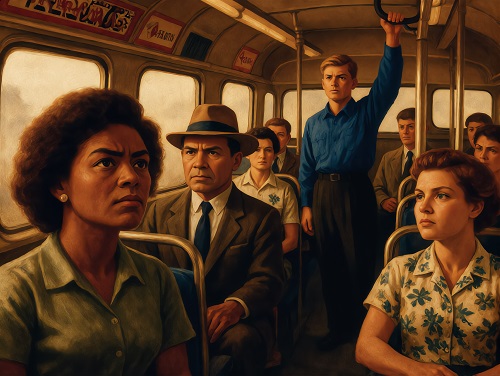
I crowded into the MARTA bus headed toward downtown Atlanta. I grabbed a seat as the bus filled up. A Black woman in a gray dress and heels got on, and I noticed there was no available seat, so I rose and moved toward the back, giving her my seat. As I got situated near the rear door, I wrapped my arm around the bus rail and placed my feet appropriately to keep me steady as the bus stopped and started along the rest of the trip to Central City Park. As I stood there, I started looking at the man sitting near me and realized it was Mr. Olivares. He was heading to his job downtown. I had not seen him in years, and initially he did not recognize me.

I had grown tremendously since I used to run through his living room alongside his children who were near my age—Paul and Vivian.
I met Paul in about third grade after his family emigrated from South America. The family included at least two youths near my age and some older siblings as well. I don’t know what drew me to Paul initially.
Through most of my elementary school experience, all the students were white, despite going to school after integration and during a program referred to as M-to-M transfer, where the county would bus students to schools that were demographically different.
As best I recall, Paul was the first student from a different country or culture that I met—especially someone speaking a different language: Spanish.
We became fast friends and began playing together during recess at school. Soon, I started visiting his home and joining his family for dinner, and he would visit ours as well. I began learning enough Spanish to get by as I visited his home and spent time among his siblings.
I guess it was my parents’ open and caring attitude toward people—whom some Southern whites of that era may have viewed differently because of color, culture, or faith—that allowed me the freedom to reach out and not feel I was doing something out of the ordinary.
In fact, perhaps it was the early boundaries that my own parents had faced as they overcame the “hillbilly” stereotypes while migrating from Appalachia into the city and seeking acceptance in Atlanta society that helped them later form the attitudes that shaped me.
So the fact that Paul was from somewhere else never fazed me as a child; it just made our time together of greater interest to me.
At some point, I lost my friend Paul when his parents were able to move him from public school to private school.
I still remember the conversation when he asked me to see if my parents would consider moving me as well. We did discuss it, but my folks stuck with the public school route, so our diverging paths forced us to focus on new friendships. Sadly, I had no need to speak Spanish anymore until I reached my studies in high school, and by then, it was like starting over completely.
It would be a while before Dresden Elementary would see another student who was not white; the next family would be Chinese from Hong Kong. In my grade was Nin Chung Szeto, and once again, I found another friend. In this case, however, I didn’t learn Chinese, but in two years’ time, I certainly had an impact as I helped teach Nin Chung English. I am sure he was burdened by my Southern accent for years. Like Paul, his path also diverged as his family moved west. We kept in touch by letters for some time, but eventually the practice faded. Still, I knew that Nin Chung—by then, he had chosen the name John—was carving out his own future in America.
When the seat next to Mr. Olivares opened up, I sat down and reintroduced myself, explaining that I was on my way to classes at Georgia State University. He caught me up on Paul and Vivian. I asked him to pass my greetings to them, and Mr. Olivares and I would regularly exchange greetings as we both commuted. It would be years later, in a Winn-Dixie grocery line, when Paul and I would next meet. Now, both out of college and making our own lives, we were miles away from those young boys we had been when our friendship started. Though we said we would get together sometime, we were in different places and did not follow through.
While the paths that life had in store for Paul, John, and me were not ones that would keep us connected, for me those youthful experiences enriched my life and allowed me to continue expanding my opportunities to know more about the people I meet, whether from a world away or just down the street.
Find more stories from Randall’s youth experiences in his Encouragers Book Series www.RandallFranks.com/Store .