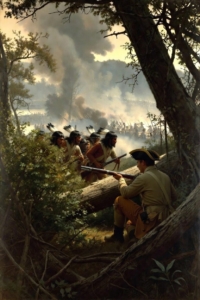
Retreating on foot through the smoke and chaos, young Sergeant Giles Parman pulled his musket close and slipped into an overgrown thicket, using a fallen oak log as cover. Three Iroquois warriors passed within yards of him, their war cries echoing as they hunted stragglers. That desperate moment of survival would haunt him for the rest of his life.
 One of the greatest motivating forces in wartime is the stories of fellow countrymen who suffer at the hands of the enemy. My 6th great-grandparents, Giles and Elizabeth Parman, lived such a story—one deeply interwoven with one of the Revolutionary War’s most devastating frontier defeats.
The Battle of Wyoming, also known as the Wyoming Massacre, occurred on July 3, 1778. What began as a military engagement soon became a sensationalized horror that spread across the colonies, fueling outrage and patriotic resolve.
Giles Franklin Parman Sr. (SAR Patriot # P-265930), born in 1758 in the Wyoming Valley, and his wife Elizabeth Penn were raising two young children on their roughly 100-acre homestead in the Plymouth District. At the time, this area was part of Northampton County, Pennsylvania (later Luzerne County). The Wyoming Valley itself formed a fertile, canoe-shaped corridor stretching 20 to 25 miles along the North Branch of the Susquehanna River and measuring about 3 to 6 miles wide between the flanking Appalachian mountain ridges.
Word of the invading force spread rapidly through the valley’s tight-knit farming communities. A mixed army of British-allied Loyalist Rangers—about 110 men under Major John Butler—and roughly 460–600 Iroquois warriors, primarily Seneca led by chiefs Sayenqueraghta (Old Smoke) and Cornplanter, had entered the northern valley around June 30–July 1. They quickly overran smaller outposts, destroying farms, running off livestock, and killing or capturing some residents in the prelude to the main assault.
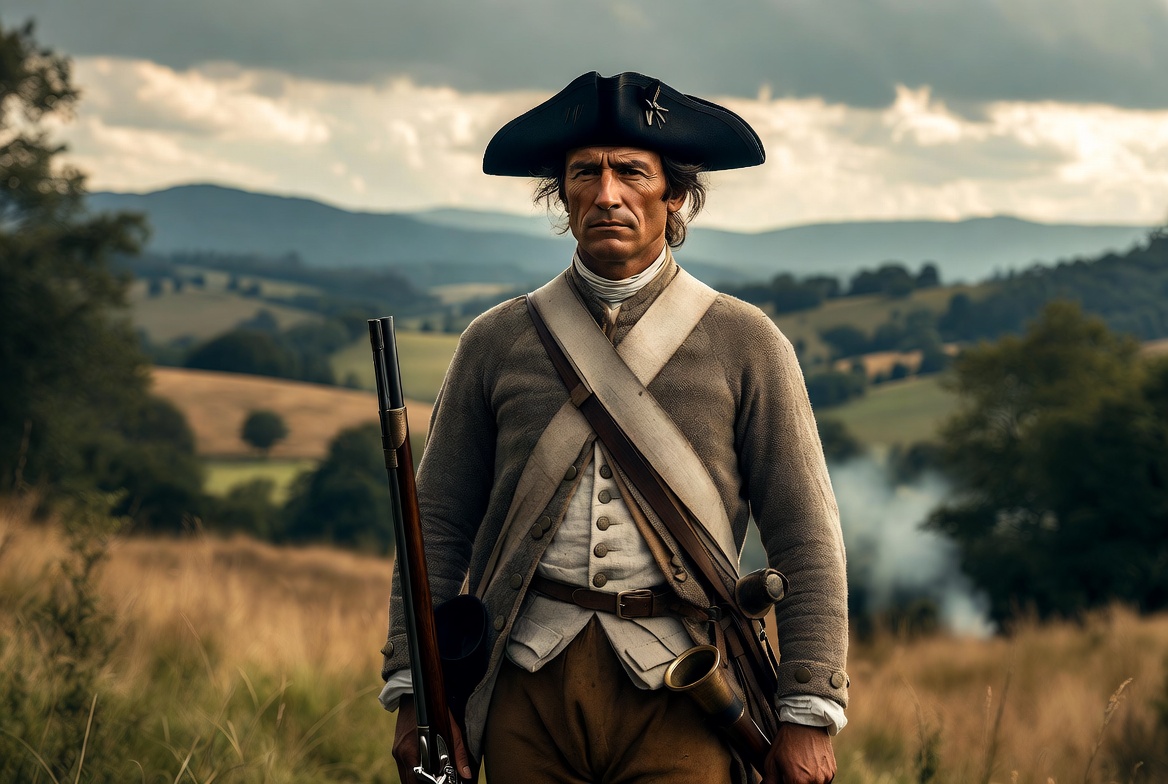
At about age 19–20, Giles was already serving in the Pennsylvania militia, which required all able-bodied men aged 18–53 to answer the call. As a sergeant in the Northampton County Militia, he likely led a small squad of 10–20 local farmers. With his own homestead threatened and his young family at risk, he probably loaded Elizabeth and the children into a wagon and hurried them to the safety of Forty Fort (near modern Kingston/Wilkes-Barre), the main Patriot stronghold, before mustering with his men.
Inside Forty Fort, a heated debate raged among the roughly 375 Patriot defenders (five companies of militia plus a small Continental detachment). Lieutenant Colonel Zebulon Butler, a Continental officer home on furlough, and Colonel Nathan Denison urged caution, advising the men to remain behind the stockade and await reinforcements. Hot-headed subordinates, including Captain Lazarus Stewart, demanded an immediate offensive to protect homes and families. The majority voted to march out.
On the hot afternoon of July 3, the Patriot force—accompanied by fife and drum playing “St. Patrick’s Day in the Morning”—advanced northward from Forty Fort to open ground near Kingston. Giles and his men joined the formation as the Patriots established a battle line and initially pushed back the Loyalist Rangers with disciplined volleys. The crack of musket fire filled the air, but the line’s terrifying collapse soon became apparent amid smoke and screams as the right flank gave way under the hidden assault by Iroquois warriors.
Giles and his squad were suddenly inundated by war cries and a galling fire that shattered the Patriot line. The battle turned into a chaotic rout within 30–45 minutes. Panic spread as men fled toward the river, woods, or forts. Historical estimates place Patriot deaths at 160–300 or more in the fighting and immediate pursuit, with many scalped or killed while trying to escape. Loyalist and Iroquois losses remained light.
Giles survived the battle and made a desperate way back toward his family, with pursuers close behind. The scene around him was one of horror—neighbors cut down, the valley’s defenders broken in what colonists quickly called a “massacre.”
The exact path Giles and his young family took in the immediate aftermath has been lost to time. Did they remain sheltered in Forty Fort? Or did they risk returning briefly to their Plymouth District homestead to salvage what they could?
On July 4, Colonel Denison surrendered the fort under terms negotiated with Major Butler: the defenders would not take up arms again, and private property would ostensibly be respected. Family accounts and lore suggest Giles continued fighting for a total of about seven years in militia service (a figure repeated alongside his friend Michael Girdner), so he may not have been present for the formal surrender—allowing him to keep defending the region without strictly honoring the agreement.
Despite the capitulation, discipline among some Iroquois warriors broke. In the hours and days that followed, scattered killings, plundering, and burnings occurred across the valley. Homes and farms were looted and torched; livestock was driven off. While Major Butler largely restrained his white troops and claimed no non-combatants were harmed, the frontier reality included real brutality and revenge—motivated in part by earlier Patriot raids on Iroquois villages. Exaggerated tales of atrocities (including stories of the debated “Bloody Rock”) spread rapidly through colonial newspapers, inflaming public fury and helping inspire the 1779 Sullivan Expedition against the Iroquois.
Giles and Elizabeth helped bury and mourn neighbors and friends. They endured the “Great Runaway”—the desperate flight of hundreds of women, children, and elderly into the mountains and swamps, where many perished from exposure. Giles continued militia duties protecting the frontier through much of the remaining war, a common pattern for Northampton County men focused on local defense rather than distant Continental campaigns.
After the war, the family remained in Pennsylvania for a time. Giles sold and migrated westward around 1792–1793 to Greene County, Tennessee, settling along the Nolichucky River. There he served as a justice of the peace, road overseer, election inspector, and helped found the Flat Branch/New Providence Baptist Church in 1803. Elizabeth died before January 10, 1799. Giles then remarried Phoebe (Gilbert) Woolsey. Across both marriages, he raised roughly 11–12 children. Later, the family moved to Knox County, Kentucky (near modern Corbin), where Giles received a land grant, built a plantation on the Cumberland River, and raised horses. He died there in 1832.
Giles represents the archetypal Revolutionary frontier Patriot: an ordinary young farmer and family man thrust into extraordinary circumstances. Unlike officers or Continental soldiers in major eastern battles, he and thousands like him in the Pennsylvania and New York back country fought a grinding, personal war of home defense against raids that blurred the lines between military action and civilian terror. His survival at Wyoming, continued service, and subsequent life as a community leader and westward migrant embody the Revolutionary promise—defending liberty on the edge of settlement, then helping build new communities in Tennessee and Kentucky as the nation expanded. Giles’s life mirrors the resilience of countless unsung Patriots who paid the price for the freedoms that followed.
Read more of Randall’s writings in his others books found at Randall Franks Store .