
Ordinary Heroes: The Remarkable Founders of America
There are many ways to celebrate the founding of our country. Two hundred and fifty years ago, 56 men gathered to debate how the 13 colonies would move forward as a new nation. These delegates came from every colony, representing a remarkable cross-section of American life. Some were wealthy and well-established in their professions, while others were ordinary tradesmen and farmers. That, in many ways, was what America’s early years were all about. It wasn’t about nobility or inherited privilege—it was about ordinary people having a voice in shaping their future whether they were in that room or serving near their home.
One such man was frontier farmer Thomas Arnett Sr. (1740–1808) of Augusta County, Virginia. Soon after the battles of Lexington and Concord, he volunteered as a private in Captain Pryor’s Militia Company. In addition to his military service, he contributed 300 pounds of flour from his modest farm to support the Continental Army. From 1775 until the war’s end, Arnett found multiple ways to have his say in the struggle for independence.
The spirit of resistance first took root in Boston, where tradesmen and ordinary citizens publicly objected to the Crown’s oppressive taxes, beginning with the Stamp Act. The Sons of Liberty emerged from that early resistance, spreading the cause of liberty across the colonies from the shadow of Boston’s Liberty Tree. Declaration signer Samuel Adams was a founding member of the group. Though he struggled financially as a businessman—he even lost the family brewery—his passion for creating a free nation proved far more valuable. Through his tireless efforts, Adams helped lay the groundwork for generations to come.
Another signer, George Walton of Georgia, rose from humble beginnings. Orphaned young and raised by an uncle, he was apprenticed to a carpenter. Largely self-educated, he became a lawyer and eventually served as governor of Georgia.
Signer Abraham Clark of New Jersey showed little interest in personal wealth. As an attorney, he devoted much of his practice to helping ordinary people who could not afford legal representation. Contemporaries described him as “limited in his circumstances, moderate in his desires, and unambitious of wealth.”
It was John Adams of Massachusetts who famously observed that about one-third of the population supported the Revolution, one-third remained Loyalist, and one-third stayed neutral. Among the founders who shaped the nation’s spirit, Adams stands out as one of the most influential. He was often unpopular among his fellow delegates, largely because of his relentless push for independence. It was Adams who helped steer the young Thomas Jefferson of Virginia into the role of primary author on the committee tasked with drafting the colonies’ grievances against King George III.
That committee included Adams, Jefferson, Benjamin Franklin of Pennsylvania, Roger Sherman of Connecticut, and Robert R. Livingston of New York. It was Virginia’s Richard Henry Lee who first advanced the cause with his resolution declaring the colonies “free and independent states” in June 1776. The committee was formed in response, and by July they had prepared a draft for debate.
In his original draft, Jefferson included a powerful condemnation of the slave trade and slavery itself. Unfortunately, that passage was struck out after objections from delegates in both the northern and southern colonies. While the focus remained on achieving independence, the ideal of freedom for all had been planted—though it would take nearly another century and the lives of hundreds of thousands of soldiers before that ideal began to be realized.
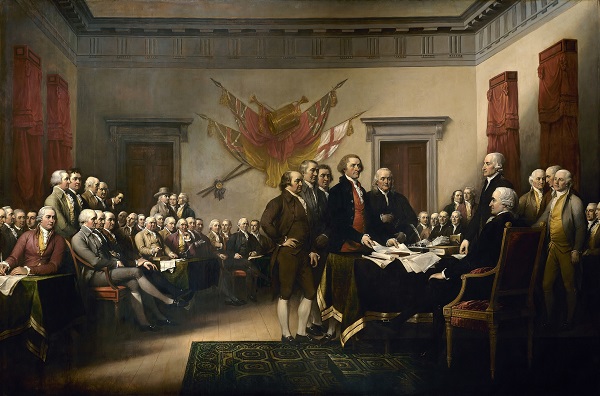
The Congress approved the final text on July 4, 1776—the date we celebrate as our nation’s founding. The actual signing of the engrossed document took place primarily on August 2, 1776, a moment famously reflected in John Trumbull’s iconic 1818–1819 painting of the June 28th presentation by the committee.
Among the signers, Roger Sherman of Connecticut stands in a class by himself. A self-made man who began his working life as a cobbler, Sherman is the only delegate to sign all four of the nation’s foundational documents: the Continental Association; the Declaration of Independence, the Articles of Confederation, the U.S. Constitution, and he also served on the committee that helped draft the Bill of Rights. A version of the Bill of Rights in his handwriting still exists today.
These men—and the countless ordinary citizens who supported them—created something unprecedented in world history. In an age dominated by monarchies, they offered the radical idea that ordinary people could govern themselves. They gave the world a new hope for freedom and self-determination. Two hundred and fifty years later, that experiment continues. Whether by attending a Revolutionary War reenactment, participating in a grave marking ceremony for one of these patriots, joining a local Independence Day celebration, or watching a parade, there are many meaningful ways to honor their extraordinary legacy this year. If that isn’t worth celebrating, I don’t know what is.
The columnist is related to Thomas Arnett Sr., paternal 6th Great Grandfather; and he is related to 48 signers of the Declaration including most of those mentioned above.
Read other writings from Randall Franks in his books: Store