Posts

Ordinary Heroes: The Remarkable Founders of America

There are many ways to celebrate the founding of our country. Two hundred and fifty years ago, 56 men gathered to debate how the 13 colonies would move forward as a new nation. These delegates came from every colony, representing a remarkable cross-section of American life. Some were wealthy and well-established in their professions, while others were ordinary tradesmen and farmers. That, in many ways, was what America’s early years were all about. It wasn’t about nobility or inherited privilege—it was about ordinary people having a voice in shaping their future whether they were in that room or serving near their home.

One such man was frontier farmer Thomas Arnett Sr. (1740–1808) of Augusta County, Virginia. Soon after the battles of Lexington and Concord, he volunteered as a private in Captain Pryor’s Militia Company. In addition to his military service, he contributed 300 pounds of flour from his modest farm to support the Continental Army. From 1775 until the war’s end, Arnett found multiple ways to have his say in the struggle for independence.

The spirit of resistance first took root in Boston, where tradesmen and ordinary citizens publicly objected to the Crown’s oppressive taxes, beginning with the Stamp Act. The Sons of Liberty emerged from that early resistance, spreading the cause of liberty across the colonies from the shadow of Boston’s Liberty Tree. Declaration signer Samuel Adams was a founding member of the group. Though he struggled financially as a businessman—he even lost the family brewery—his passion for creating a free nation proved far more valuable. Through his tireless efforts, Adams helped lay the groundwork for generations to come.

Another signer, George Walton of Georgia, rose from humble beginnings. Orphaned young and raised by an uncle, he was apprenticed to a carpenter. Largely self-educated, he became a lawyer and eventually served as governor of Georgia.

Signer Abraham Clark of New Jersey showed little interest in personal wealth. As an attorney, he devoted much of his practice to helping ordinary people who could not afford legal representation. Contemporaries described him as “limited in his circumstances, moderate in his desires, and unambitious of wealth.”

It was John Adams of Massachusetts who famously observed that about one-third of the population supported the Revolution, one-third remained Loyalist, and one-third stayed neutral. Among the founders who shaped the nation’s spirit, Adams stands out as one of the most influential. He was often unpopular among his fellow delegates, largely because of his relentless push for independence. It was Adams who helped steer the young Thomas Jefferson of Virginia into the role of primary author on the committee tasked with drafting the colonies’ grievances against King George III.

That committee included Adams, Jefferson, Benjamin Franklin of Pennsylvania, Roger Sherman of Connecticut, and Robert R. Livingston of New York. It was Virginia’s Richard Henry Lee who first advanced the cause with his resolution declaring the colonies “free and independent states” in June 1776. The committee was formed in response, and by July they had prepared a draft for debate.
In his original draft, Jefferson included a powerful condemnation of the slave trade and slavery itself. Unfortunately, that passage was struck out after objections from delegates in both the northern and southern colonies. While the focus remained on achieving independence, the ideal of freedom for all had been planted—though it would take nearly another century and the lives of hundreds of thousands of soldiers before that ideal began to be realized.

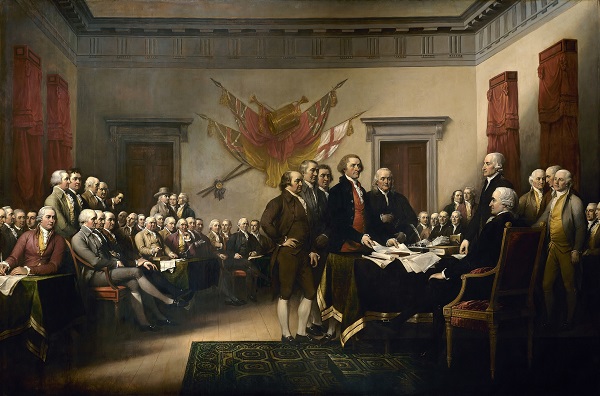
The Congress approved the final text on July 4, 1776—the date we celebrate as our nation’s founding. The actual signing of the engrossed document took place primarily on August 2, 1776, a moment famously reflected in John Trumbull’s iconic 1818–1819 painting of the June 28th presentation by the committee.

Among the signers, Roger Sherman of Connecticut stands in a class by himself. A self-made man who began his working life as a cobbler, Sherman is the only delegate to sign all four of the nation’s foundational documents: the Continental Association; the Declaration of Independence, the Articles of Confederation, the U.S. Constitution, and he also served on the committee that helped draft the Bill of Rights. A version of the Bill of Rights in his handwriting still exists today.

These men—and the countless ordinary citizens who supported them—created something unprecedented in world history. In an age dominated by monarchies, they offered the radical idea that ordinary people could govern themselves. They gave the world a new hope for freedom and self-determination. Two hundred and fifty years later, that experiment continues. Whether by attending a Revolutionary War reenactment, participating in a grave marking ceremony for one of these patriots, joining a local Independence Day celebration, or watching a parade, there are many meaningful ways to honor their extraordinary legacy this year. If that isn’t worth celebrating, I don’t know what is.

The columnist is related to Thomas Arnett Sr., paternal 6th Great Grandfather; and he is related to 48 signers of the Declaration including most of those mentioned above.

Read other writings from Randall Franks in his books: Store

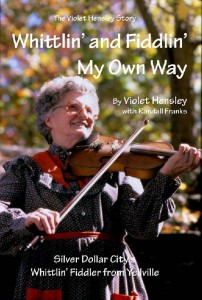
Whittlin’ and Fiddlin’ My Own Way by Violet Hensley with Randall Franks
243b2f156cbb02b5520e5fda9858df7c_plf5Whittlin’ and Fiddlin’ My Own Way by Violet Hensley with Randall Franks

$26.50


I never thought I would be writing about my life, my music and my fiddle makin’,” she said. “I could have never dreamed coming from a farm in the backwoods of Arkansas that the things I learned on that farm would make me a TV personality and gain me fame around the world.”

The Arkansas Living Treasure Award winner from Yellville, Arkansas learned to fiddle in 1928 and make fiddles watching her father George W. Brumley in the community of Alamo, Arkansas in 1932.

Hensley joined in a three-year effort with award-winning journalist and author Randall Franks, “Officer Randy Goode,” from TV’s “In the Heat of the Night,” to complete her memoir.

“It was an amazing experience to work with Violet weekly to refine the experiences from her life and compile a book which not only reflects what many rural families endured in America in the 20th century but what was most unique about Violet as she grew artistically, to find folk music stardom at nearly 50.”

He said Hensley raised a family of nine with her late husband Adren while he moved the family from town to town and state to state.

“With the advent of the folk music revival, Violet’s blossoming musical and fiddle-making talents, caught the attention of Grammy ® winner Jimmy Driftwood and the owners of Silver Dollar City in Branson, Missouri,” he said. “She joined the crafter’s cast at Silver Dollar City in 1967, becoming part of the City’s celebrities who used radio, television, and newspapers to invite visitors to the amusement park.”

Peter Herschend, Herschend Family Entertainment co-founder and owner, said Violet is one of the City’s most unique citizens.

“In the early years of Silver Dollar City, Violet, Don Richardson and I, along with an interesting assortment of the City’s colorful characters, would spend weeks on the road together…all devoted to promoting SDC,” he said. “I came to know Violet for the amazing wonderful woman that she is. She would amaze us with stories of field plowing with her mules. Then a new Violet would seem to appear when she would sit for an interview with some grizzled reporter (reporters who probably didn’t believe she was real), and she would proceed to win them over with her charm, her skills as an artist, and her talent as a musician.’

Sharing her talents in front of millions, Hensley became one of the first woman fiddlers to reach a large international audience appearing at the Smithsonian’s Festival of American Folklife, festivals, colleges, and on countless local, regional and national television and radio shows such as “The Beverly Hillbillies,” “Captain Kangaroo,” and “Live! with Regis and Kathie Lee.” according to Franks.

“I hope folks will enjoy getting a glimpse at what my near century on this world has been,” she said. “It’s been a hoot so far and what’s even better is while the book is written – the story continues. I hope folks will join me for what is yet to come, they can start by reading the book.”

The 258-page soft cover book from Peach Picked Publishing includes 145 photos.

Silver Dollar City Folk Music Legend Violet Hensley shares 98 years of experiences from a backwoods farm to international folk music fame.

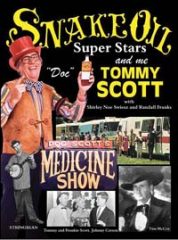
Snake Oil, Superstars and Me by “Doc” Tommy Scott, Randall Franks and Shirley Noe Sweisz

9781425991890_cover.inddSnake Oil, Superstars and Me 

$38 including shipping


Autograph by Randall Franks? Please Provide Name?


“Doc” Tommy Scott, Shirley Noe Sweisz and Randall Franks
A 700- page autobiography with more than 500 photos highlighting Ramblin’ “Doc” Tommy Scott’s 90 years in Film, Television, Stage and Radio and all the superstars that were part of his life, show and career. We will pay postage and handling.

Tommy Scott (1917-2013) liked to tell the story of the time he met David Letterman, when the famous TV show host stormed off the stage because his own guest overshadowed him with his musical ramblings. Known for his rambling and roaming, this Hillbilly, western, country and bluegrass artist could never plant his roots in one place, so for a while he traveled and played the guitar, and later, he traveled and sold a cure-all remedy known as snake oil. The  entrepreneur, artist, and actor tells about his lifetime of personal discovery in his memoir, “Snake Oil, Superstars, and Me”

Different segments of his life can be labeled and described by his various nicknames. When he was just Tommy, the son of a farmer in northern Georgia, he decided he needed to make a name for himself in the music world. He escaped to join the Medicine Show, a musical and acting caravan that traveled across the U.S. There, he answered to the name “Peanut,” taking on the role of a guitar-playing clown. Next he was “Texas Slim” on a radio show, where he infused comedy and music with his ventriloquist doll-partner, Luke McLuke making his way to star on the Grand Ole Opry in the 194os. And then he was “Rambling Tommy,” a guitar player and music composer. Later in life, he became “Doc Tommy Scott,” selling snake oil as a medicine man in traveling exhibits.

No matter what name he went by, he always loved Frankie, a southern model and starlet from his hometown. When she took his last name, she became his “right hand man,” smoothing over rough business deals in her graceful way. The two wandered together when Tommy played and entertained many musicians in their home. As a young couple, they starred in a traveling show group and appeared in Tommy Scott shows that were later transformed into syndicated films and television.

Although he went by many names and lived many lives, one part of Tommy always remains the same. He loved igniting a crowd and hearing the roaring applause. He didn’t particularly love the praise, but he loved the response. He claimed snake oil is a cure-all remedy in his traveling shows, but even if it isn’t medically proven, Tommy cures the audience with gales of laughter.

“If you think it will help then it will,” Scott’s mentor advised him once. “If you have the faith for it, the liniment will stop the pain while the herbal treatment sets you to running! One thing for sure, though, if you visit a medicine show, for an hour and a half you will leave your burdens behind.”