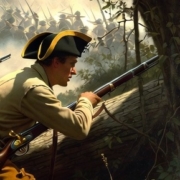
Echoes from King’s Mountain: Ancestors, Sacrifice, and the Songs of Freedom
As we draw nearer to the 250th anniversary of American independence, I find myself reflecting on the ancestors who answered the call to arms, ordinary frontiersmen who became heroes in the fight to free the colonies from British rule.
My fifth-great-grandfather, Charles Kilgore, was one of five Scotch-Irish brothers who heeded the Revolution’s summons. Born in 1744 in County Clare, Ireland, Charles traced his roots to the Kilgours of Fife, Scotland. Family lore connects them to Clan Douglas, fierce warriors who battled for Scottish independence and stood with the Jacobite risings of the 1700s.Around 1763, Charles and his brothers—Hiram, Robert, William, and James—crossed the Atlantic, settling first in North Carolina before pushing to the Virginia frontier. There, Charles married Martha McIlhaney, raised eight children on a 600-acre plantation, and joined the Washington County Militia under Captain James Dysart in Colonel William Campbell’s regiment. His four brothers enlisted alongside him. They were part of the legendary Overmountain Men, rugged settlers from beyond the Appalachian Mountains who embodied the spirit of the frontier.
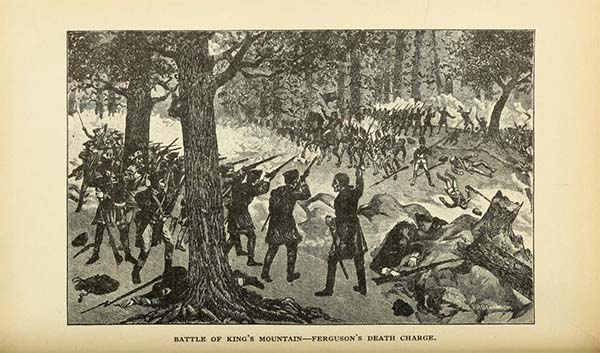 In late September 1780, these men mobilized after British Major Patrick Ferguson threatened to “march over the mountains, hang their leaders, and lay waste the country with fire and sword.”
The brothers joined hundreds of others in a grueling 330-mile march over rugged terrain, enduring rain and hardship for two weeks to confront the Loyalists.
Their defining moment arrived on October 7, 1780, at Kings Mountain—a rocky, wooded spur on the North Carolina-South Carolina border that proved a pivotal turning point in the Southern Campaign of the Revolutionary War.
Roughly 900 Overmountain Men encircled about 1,100 Loyalists perched atop the ridge. Unlike traditional European line battles, the Patriots employed guerrilla tactics suited to the terrain: advancing uphill under cover of trees and rocks, using their accurate long rifles to pick off enemies while dodging bayonet charges.
The Kilgores’ militia charged from the north, pressing through thick smoke and the crack of musket fire. Hiram fell in battle; Robert and Charles were gravely wounded. Yet, they helped secure the summit as Loyalist leader Major Patrick Ferguson was slain, his forces crumbling in just over an hour.
From the southeast, my Sherrill kin—fourth- and fifth-great-grandfathers Adam and Samuel Sr., along with uncles
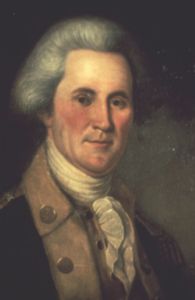
Uncle Col. John Sevier
Samuel Jr. and George—fought under my uncle Colonel John Sevier, their rifle fire converging with the Virginians’ assault.
On the southern flank, my sixth-great-grandfather Captain John Weir’s “South Fork Boys” pushed forward despite early losses, tightening the pincer that broke the Loyalists.The toll was stark: Loyalists suffered 157 killed, 163 wounded, and 698 captured—nearly their entire force—while Patriots lost only 28 killed and 62 wounded, a testament to their superior marksmanship and resolve.
In the aftermath, nine Loyalist officers were hanged for alleged atrocities, underscoring the war’s brutal, brother-against-brother nature.
This victory demoralized British forces in the South, boosting Patriot morale and prompting Lord Cornwallis to abandon his invasion of North Carolina.
Thomas Jefferson later hailed it as “the joyful annunciation of that turn of the tide of success which terminated the Revolutionary War with the seal of our independence,” paving the way for the decisive siege at Yorktown a year later.
Amid the chaos, my Loyalist-turned-Patriot ancestor, fifth-great-grandfather Captain Billy Green, initially defended the hilltop. Captured and sentenced to hang, he escaped and later realigned with the Patriots. This meant I had family on both sides—an experience echoed throughout history, from Scotland’s clan wars to civil conflicts worldwide.
On that fateful day, all five Kilgores stood shoulder to shoulder, shedding blood in a clash that shifted the war’s momentum. Charles, shot through the body, survived only because Martha and their young daughter Mary braved the wilderness in a wagon to retrieve him and bring him home to Virginia. Robert also recovered from his wounds, but tragically lost his life to Mingo Indians on December 31, 1782, during a hunting expedition. His family then moved in with Charles’s for a time.
Charles earned a pension in 1809 and passed away in Greene County, Tennessee, in 1823. His daughter Rebecca married Adam Sherrill in the 1790s, uniting two families of Kings Mountain veterans in bonds forged through shared sacrifice.
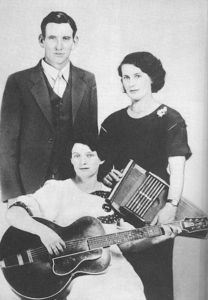
The Carter Family
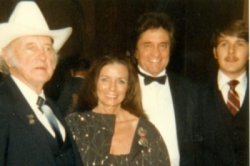
Randall Franks (right) with Johnny and June Carter Cash and Bill Monroe in 1984.
Charles and his kin remind us that the Revolution was won by everyday men and women—farmers, brothers, and families—who rose to extraordinary heights. The five Kilgores symbolize the unbreakable ties that compelled them to leave their homes and fight side by side for freedom. Because they did, generations since have lived without bowing to distant monarchs.
On a personal note, I am privileged to descend from these men. Through the Kilgore roots, I share them as grandfathers with notable figures in Appalachian music: All three original Carter Family members—A.P., Sara, and Maybelle—are my cousins. Sara and Maybelle descend from Charles, like me; A.P. from brother Robert. Thus, connecting me also to the Johnny and June Carter Cash clan. These ancestors’ lives truly gave us all something to sing about.