Posts

America’s Fiddle Legacy – Skillet Lickers’ Chicken House

As I glanced up from the worn linoleum floor, the air thrummed with the pulse of strings. Three fiddlers, two guitarists, and a banjo player surrounded me in their ladder back chairs, their notes weaving a spell that held me captive. I was a young fiddler then, hanging on every phrase from Gordon Tanner, Paul Jordan, and Dallas Burrell, desperate to steal a lick or two to spark my own playing.

In my North Georgia hills, these men were more than musicians—they were torchbearers of a fiddle tradition that helped birth hillbilly music, a sound that echoed from porch swings to the world’s stages. Gordon Tanner’s legacy loomed largest. As a teenager in 1934, he recorded the million-selling “Down Yonder” with his father, Gid Tanner and the Skillet Lickers, a band whose raw, joyful energy defined early country music. Their records, cut in makeshift studios and broadcast through crackling radios, carried Georgia’s red clay soul to listeners far beyond the Appalachians. Gordon’s Gold Record was proof of their reach, a testament to a family that turned fiddles into time machines.
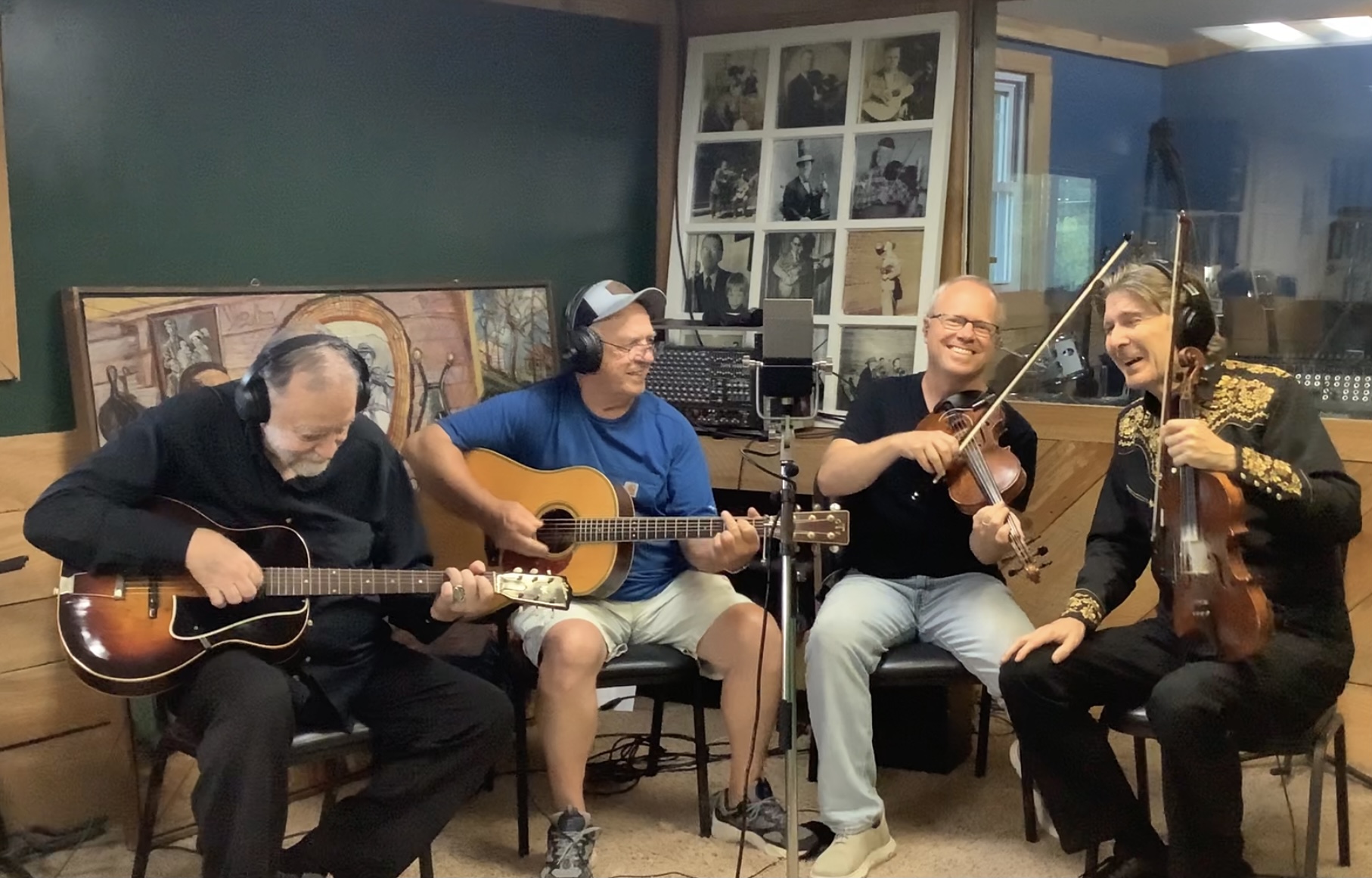
The Skillet Lickers and Paul Puckett add their historic flair with Randall Franks

Last week, I stepped into that history, recording with Gordon’s son, Phil, and grandson, Russ, alongside Paul Puckett in Dacula, Georgia—the Skillet Lickers’ hometown. Our studio was no polished soundstage but the Tanners’ old chicken house, transformed into a shrine of musical heritage. Faded photographs, yellowed posters, and framed 78s lined the walls, each artifact whispering of Tanner legends and others like Fiddlin’ John Carson, Riley Puckett, Clayton McMichen, Lowe Stokes, and Anita Sorrells Mathis. These pioneers dominated Georgia’s music scene in the early 20th century, their bow strokes and guitar runs shaping a sound that flowed through my mentors into my own fingers, like a river carving its path through time.

Though the Skillet Lickers’ commercial peak faded by mid-century, their music never dimmed. It lived on in the hollers and hamlets of the South—at raucous fiddle contests, folk and bluegrass festivals, weathered pickin’ barns, and late-night living room jams where players swapped tunes until dawn.

As a boy, I’d sit cross-legged at these gatherings, my fiddle resting on my knee, watching weathered hands coax magic from strings. Those moments forged my love for the music, passed down not through sheet music but through calloused fingers and shared stories, generation to generation.

Recording in that chicken house felt like stepping into a dream. As Phil, Russ, Paul and I traded notes, our music became a bridge across decades, blending the Skillet Lickers’ fire with band I fiddled for, Doodle and the Golden River Grass. We were laying tracks for “A Zippedy Doodle Day,” a charity album to fund Appalachian music scholarships, uniting Georgia’s first fiddle band with its last. Each pluck and bow stroke was a brushstroke on a rhythmic canvas, painting a sound we hope will resonate for years, just as the Skillet Lickers’ records still stir my soul. The Tanners’ keepsakes—framed record sleeves, a worn fiddles, a concert poster —surrounded us, grounding our work in their legacy. I thought of my younger self, a boy mesmerized by flying bows and rosin dust swirling in the air, dreaming of touching the magic of my heroes. Now, here I was, not just chasing their sound but adding my own notes to their story. It’s a humbling honor, one that carries a responsibility to keep this music alive for the next generation.

The Skillet Lickers’ spirit reminds us that music is more than sound—it’s a living thread, connecting past to present, heart to heart. Our project aims to ensure that thread endures, supporting young musicians who’ll carry the fiddle’s voice forward. In that chicken house, we weren’t just recording; we were keeping a promise to the music that raised us and the people who inspired us. Learn more about the Skillet Lickers at www.SkilletLickers.org. For a preview of our charity project, visit www.RandallFranks.com/A-Zippedy-Doodle-Day

An American Legend and the Opry – Violet Hensley

IMG_2038

Violet Hensley on stage at the Grand Ole Opry on Aug. 6. (Photo by Marcia Campbell/http://www.facebook.com/marciacampbellradio)

There are moments which bring people together. Common experiences such as championship wins of athletes or sporting teams, pivotal events which shape our nation or world, or iconic performances or awards highlighting those who inspire us through performance.
I was honored to be among just such a group on Aug. 6, 2016. I traveled to Nashville to see a legendary folk fiddle performer and maker Violet Hensley. I spent a couple years of my life helping Violet bring together her life story for the book “Whittlin’ and Fiddlin’ My Own Way: The Violet Hensley Story.”
God Lord willing, Violet will mark her centennial as she celebrates her 50th year as Silver Dollar City’s longest serving spokesperson and folk artisan at a special event on Oct. 21 in Branson, Mo.
She has entertained countless millions both live and on television through appearances on American standards such as “The Beverly Hillbillies,” “Captain Kangaroo,” “To Tell the Truth,” “Regis and Kathie Lee” and countless other shows through decades of performing.
One performance dream which she had yet to realize was an appearance on the Grand Ole Opry. The show came on the air when she was 9 years old and was initially heard on a battery-powered radio in the rural Arkansas farm area of Alamo where she grew up. Now known as the Whittlin’ Fiddler from Yellville, it was another Arkansas fiddler named Tim Crouch who read of her dream in her autobiography and called Grand Ole Opry star Mike Snider. Snider then arranged for her to guest on his portion of the Grand Ole Opry.
The hit making country group Shenandoah had just left the stage as a place was prepared for her and though now her sight is limited by macular degeneration, her daughter walked her to the stool that stage hands had placed center stage near where all the country legends have performed.
As the Opry announcer passed the show back to Snider, the excitement was already building. He began an introduction, and barely got out his first few words out: “I’ve had the privilege to introduce a lot of great people on the Grand Ole Opry but it’s rare I get to introduce a National Treasure and I have one sitting hear beside me. This little lady was born in 1916…”
When the audience responded with a standing ovation that filled the Grand Ole Opry House. A wave of sound flooded the stage as the centenarian’s face beamed, as did that of her daughter Sandra and grandson Sterling who joined her musically on stage with Snider’s band. That moment broadcast across the world on wsmonline.com and on the same airways that she listened to as a girl with her fiddle playing father brought people lining the stage to tears.
She is one of America’s first nationally known female fiddlers and fiddle makers. She inspired generations of girls and boys on every imaginable children’s show from coast to coast to know they could play American music and even learn to build a fiddle if they desired. Someone who became the image of one of America’s most iconic theme parks and thus a part of the fabric of America itself.
Much like Dolly Parton is to Dollywood and Mickey Mouse is for Disney – Violet Hensley’s smile, laughter, wit and uplifting spirit, helped shape the family memories and experiences that fueled rhe Midwestern American culture. On this night America was giving something back to her – love for a century of entertaining, teaching, and encouraging, while all the struggles and hardships that went along with it.
Among the audience in the Opry house and listening were many of her descendants, but in a way, all of us whom she had touched through radio, TV and in person were her musical descendants. Had this occurred just a few years earlier, she probably would have placed the fiddle on top of her head and while she fiddled and sang “She’ll Be Comin’ ‘Round the Mountain,: she would have danced a little jig, but tonight she selected the fiddle tune “Angeline the Baker” and seriously applied her expertise to make her Ozark forebearers proud.
She accomplished that goal and more. I think all that were touched by the moment will always remember it. Though now the focus of our attention is split between hundreds of media sources, unlike in the days when there were just a handful of clear channel radio stations like WSM or two or three local TV stations. In those days, you knew what everyone would be talking about the next morning.
This was one of those moments to talk about. If you missed it, maybe you can at least learn more about this amazing American Legend by visiting VioletHensley.com or liking “Whittlin’ and Fiddlin’ My Own Way” on Facebook. There is much to learn about life from someone who lived 100 years, raising a large family while living as a farmer, migrant farm worker, and keeping the tradition of Ozark music thriving.