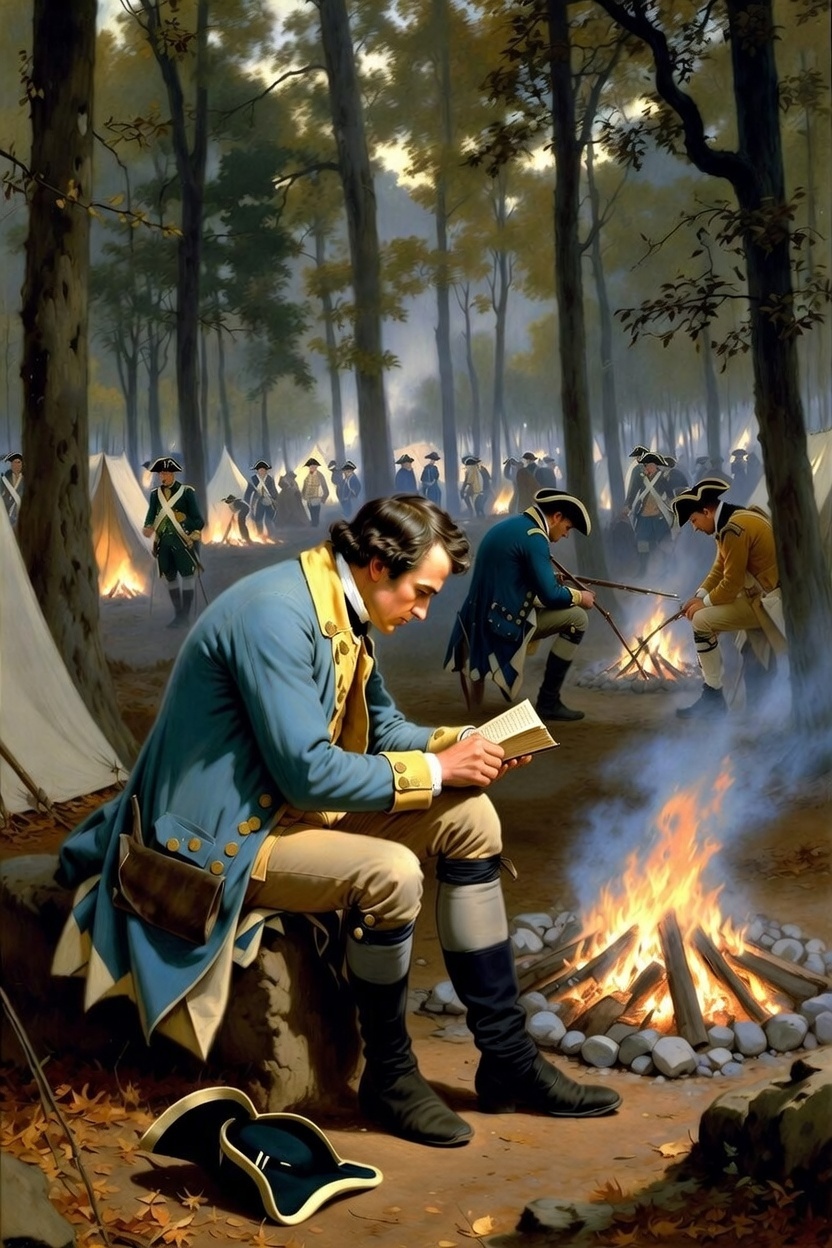
Echoes of Valor: Frederick Emert’s Revolutionary Odyssey
/in Southern Style Columns /by Randall FranksAmid the crisp autumn air of September 1777, Private Johan Frederick Emert huddled near a flickering campfire along the banks of Brandywine Creek in Pennsylvania, his woolen coat—part of the standard Continental Army uniform, dyed a faded blue and frayed from months of marching—draped over his shoulders against the evening chill cleaning his musket.
Around him, the dense woods rustled with the movements of fellow soldiers from his Pennsylvania regiment, their tricorn hats tilted low as they cleaned muskets or shared meager rations of hardtack and salted pork. The distant rumble of artillery echoed from British lines, a grim reminder of the day’s fierce engagement where Emert and his comrades had charged through smoke-filled fields, dodging grapeshot and bayonets in a desperate stand against General Howe’s advancing forces.
Born on October 11, 1754, in Berks County, Pennsylvania, to German immigrant parents, Emert enlisted as a private in the Continental Army around the war’s early days, likely in 1776, joining the 3rd Pennsylvania Regiment under Captain John Huling and Colonels Arthur St. Clair and Joseph Wood, part of the Pennsylvania Line under Brigadier General Anthony Wayne.
This unit was dispatched in May 1776 to bolster Colonel Benedict Arnold’s retreating forces in the northern theater. Emert’s movements indicate he would have been stationed at Fort Ticonderoga, where soldiers endured harsh conditions—fortifying defenses, drilling daily, and guarding against British incursions amid the rugged wilderness of upstate New York.
Compatriots’ recollections, passed down through family oral histories, paint a picture of Emert’s likely participation in the naval clash at Lake Champlain in October 1776, where American forces delayed a British invasion from Canada. As a private, his day-to-day activities would have involved sentry duty on the lakeshore, maintaining vessels or earthworks, and foraging for supplies in a landscape of dense forests and biting cold, all while facing shortages that left the army “suffering for provisions,” as he later recounted to neighbors.
By 1777, Emert’s regiment had shifted south, aligning under General George Washington. He fought at the Battle of Brandywine on September 11, where the Continentals attempted to block the British advance on Philadelphia. Amid the chaos of musket volleys and cannon fire, Emert would have maneuvered through open fields and wooded ravines, reloading his flintlock musket under pressure while coordinating with messmates like Peter Wallwur and Isaac Stewal—fellow soldiers he mentioned in stories shared years later. The defeat led to a retreat, but Emert pressed on, likely engaging in the subsequent Battle of Germantown on October 4, a foggy assault on British positions where close-quarters combat tested the resolve of Wayne’s men.
After a brief return home—where he married Barbara Anne Neidig—Emert was drafted again but hired a substitute, unwilling to leave his new bride. Soon after, another draft prompted him to enlist voluntarily for the war’s duration, committing to nearly seven years of service in total. His path under Washington and Wayne included stints near Quebec, possibly as part of northern campaigns or garrison duties, where harsh winters meant enduring frozen outposts and limited rations. In 1779, while residing in Rockland Township, Berks County, he further contributed through patriotic service by paying a supply tax to support the Continental cause.
Emert’s service culminated at the Siege of Yorktown in October 1781, a pivotal encirclement where French and American forces trapped Lord Cornwallis’s army. As a private in the trenches, he would have dug fortifications under fire, stood watch during bombardments, and witnessed the British surrender—a moment he vividly described to his children, who recalled seeing his honorable discharge papers before they were lost in a house fire.

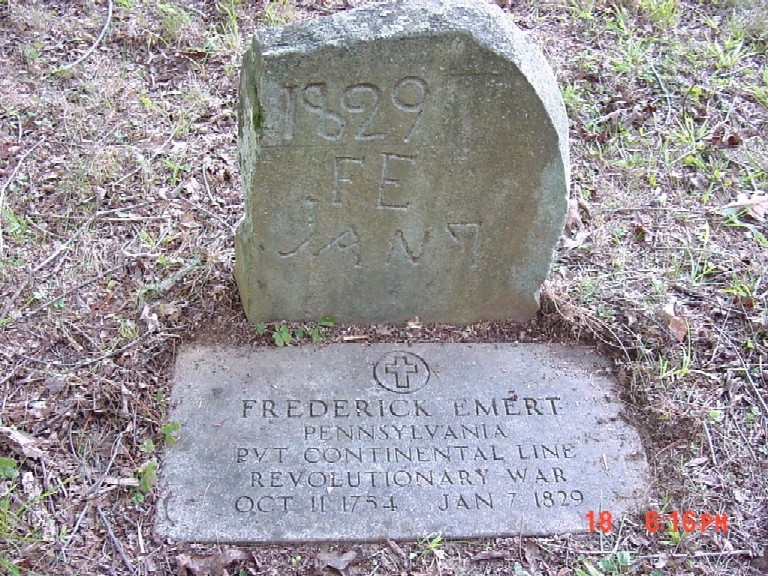
Tombstone of Frederick Emert at Emert Cove Cemetery in Sevier County, Tenn. (Photo: FindAGrave.com /Randy Emert)
Discharged at war’s end, Emert migrated south, eventually settling in what became Emerts Cove, Sevier County, Tennessee, by the early 1790s. There, he farmed the fertile valleys of the Smoky Mountains, raising a family of seven children. The Daughters of the American Revolution recognizes him as Patriot Ancestor #A036640, his service is corroborated by Continental Army rolls, pension affidavits from sons Daniel and Frederick, daughter Barbary Shults, neighbor William Smith (who served with him in the War of 1812), clergyman John Roberts, and Elizabeth Henry (widow of another veteran).
These accounts, filed in 1843–1845 for his widow’s rejected pension claim (numbered R3345V for lack of further proof), emphasize Emert’s tales of army hardships, shared over fireside conversations, underscoring the endurance of ordinary soldiers who secured independence.
Though advanced in years at age 58, Emert answered the call to arms once more during the War of 1812, enlisting for a four-month campaign in the Tennessee militia where he served alongside his neighbor William Smith against British forces. This brief but dedicated service, as attested in affidavits from his Revolutionary War pension file, underscored his lifelong commitment to defending his adopted homeland, even as he managed his farm in Emerts Cove.
Emert passed on January 7, 1829, at age 74, his legacy etched in Tennessee’s landscape and the nation’s freedom. In an era of speculation about unsung heroes, his story—pieced from family lore and military records—reminds us of the quiet valor that built America.
Frederick Emert is the Fifth Great Grandfather of the Columnist Randall Franks.
See Randall’s Revolutionary War documentary The Making of The American’s Creed and short film The American’s Creed.
The Art of Deliberate Decisions : Pacing a Response
/in Southern Style Columns /by Randall FranksLife presents us with countless crossroads—moments that can reshape our futures. Some offer greater wealth or a dream job. Others might be a romantic opportunity or even a simple choice: attend this party or that event?
We don’t always handle these decisions wisely. Sometimes we act impulsively, on the spur of the moment. Other times, we agonize for hours, weighing every angle.
Early in my career, I learned this lesson the hard way. I grew frustrated when an employer ignored a union rule that affected my earnings. Earning my union membership hadn’t been easy, so I rashly spoke up. What I failed to foresee was the fallout: the backlash from higher-ups poisoned relationships with colleagues who bore the brunt of the reaction. In the end, I relented, but the damage to goodwill was done.
As a young man, I often charged ahead without considering consequences. Poor choices revealed themselves quickly; better ones proved their worth over time. But haste rarely served me well—it short-circuited opportunities I already had in hand, simply because I misread situations or people.
Wisdom isn’t innate for everyone; many of us acquire it through experience. For me, it came gradually, as I learned to navigate life’s unpredictable currents.
I observed this in my parents. They deliberated carefully over major choices, sometimes debating intensely yet respectfully about what was best for our family. Watching their methodical approach slowly shaped my own thinking.
Later, when film roles came my way, I adopted a similar deliberateness. I’d study the script, consider the character’s impact on my career and reputation, and ask: Does this align with my values? If a project conflicted with my faith in God or my moral principles, I’d decline politely—”Thank you for the opportunity”—and move on. Only once did this bite me: producers seemed surprised by my refusal, and no further offers came from them.
Yet a closed door can lead to better ones. Life rewards those who choose wisely, often opening unexpected paths.
This thoughtful approach extended beyond acting. People began seeking my advice on career and life matters, eventually leading to my election to public office.
Life is full of lessons from our mistakes. When we apply them, we refine our decision-making—and others notice, trusting us to guide them too.
Have I always made the best choices? No. But life is an ongoing experiment in growth. With faith as our compass, God presents doors; we decide which to walk through. If we’re blessed with discernment, we choose the ones that lead to fulfillment.
Read more of Randall’s thoughts in Seeing Faith : A Devotional .
Turning Over a New Leaf : Let Go of the Baggage
/in Southern Style Columns /by Randall FranksWe all carry baggage through life—emotional weights from things we’ve done or things done to us. No matter the source, this baggage slows our journey, making us slaves to it. We feel compelled to pick it up and haul it everywhere, in everything we do.
I understand why we cling to it. For many, that burden defines our identity; without it, who are we? Some adopt a “poor, pitiful me” mindset, like Eeyore from Winnie the Pooh—constantly seeking pity from others. Others carry a chip on their shoulder, daring the world to knock it off, always ready for a fight.
Both postures drain immense energy, mentally and emotionally, just to maintain them. There are likely other ways we manifest this baggage, but these two capture the extremes.
Early Experiences
Early in life, I leaned toward the chip-on-the-shoulder style. Deep hurt fueled an “I’ll show you” attitude: I’d work harder, excel faster, strive for perfection, and achieve heights others only dreamed of. In many ways, it served me well—it channeled anger into drive and success. But underneath, it wasn’t healthy. Holding onto grudges against specific people prevented a more balanced life. I might have paused to smell the roses, nurtured relationships instead of sabotaging them to avoid hurt, or allowed vulnerability.
Would I go back and drop that chip entirely? At this stage, probably not—it shaped who I am today. Yet I was profoundly relieved when I finally unpacked the bitterness, anger, and pain from my psyche. Those people had moved on long ago, but I’d kept them neatly packed in my emotional bag. Opening it and pouring everything out was liberating. There was another season when I became more like Eeyore. Life’s trials left me missing out on milestones others enjoyed—a lasting relationship, family, an identity beyond career. It felt like “keeping up with the Joneses,” but circumstances denied me even the chance to try. That self-pity entrenched me in a rut, robbing joy from everyday life.
Finding a path
Eventually, I dumped that baggage too—the pain sustaining it—and moved forward lighter. Do I still carry some? Yes. Is it good for me? No. I work to unpack it piece by piece, aiming for a lighter load so my steps have bounce instead of thud.
As a lifelong Christian, I’ve walked with Jesus, relying on Him. Yet for years, I feared surrendering these burdens fully, even knowing He invites us to cast them on Him. Each time I’ve emptied my bag, it’s been through recognizing God’s grace and Jesus’ daily help in releasing hurts, overcoming anger, and living more abundantly.
I’m not there yet—the big trunks are now an overnight bag. I hope to empty it completely before my journey ends. The load is already so much lighter.
Read more of Randall’s inspiring thoughts in Seeing Faith : A Devotional .
Randall Franks
Author, Columnist
Comedy
Bluegrass Music
Appalachian Music
Country Music
Ministries
Entertainment Management
Share America Foundation
Contact Us
106 S Varnell Rd, #42
Tunnel Hill, Georgia 30755
Phone: (706) 963-0116