Share America Foundation Awards 2025 Pearl and Floyd Franks Scholarship to Lilly Anne Svrlingaa

The Share America Foundation, Inc. named 15-year-old Lilly Anne Svrlinga of Pickens, SC, as the 2025 Pearl and Floyd Franks Scholarship designee at the 33rd Boxcar Pinion Memorial Bluegrass Festival in Chickamauga, Ga. The scholarship honors students excelling in Appalachian musical arts. Pearl and Floyd Franks were the late parents and former entertainment managers of actor/entertainer Randall Franks, known as “Officer Randy Goode” from TV’s In the Heat of the Night.

Randall Franks (right) presents Lilly Anne Svrlinga with the 2025 Pearl and Floyd Franks Scholarship certificate at the Boxcar Pinion Memorial Bluegrass Festival . (Share America Photo)

Lilly Anne Presentation Video: https://youtu.be/Srsj5_ytNeY 

Lilly Anne Svrlinga, a 15-year-old musician from Pickens, SC, was named a 2025 Pearl and Floyd Franks Scholarship designee. The scholarship, which supports her future college education, recognizes her excellence in Appalachian musical arts.

“Lilly Anne is a talented performer whose talents encompass singing, flat picking on the guitar and leading her own shows,” Franks said. “She is already touching hearts with her talents.”

Svrlinga won the Youth Guitarist title at the Galax Fiddlers’ Convention and guitar and banjo contests at the South Carolina Fiddlers’ Convention. She has performed at prestigious venues including MerleFest, the Earl Scruggs Festival, and the Tony Rice Memorial Festival. She opened for Josh Turner, shared the stage with Josh Williams and Southern Legacy, and jammed backstage with Vince Gill at the Grand Ole Opry.

I want to thank Randall Franks for providing this scholarship to me,” Svrlinga said. “It really means a lot and will help me so much on my musical journey. I am so blessed to have the ability to play and sing such wonderful music and I use music as another way to glorify God.

I’m the kind of person that if I want something. I’m going to go for it,” she said. “I’ve been that way since the day I was born. It takes want to! I want to thank everyone for supporting me all these years. I wouldn’t be here without ya’ll. God bless and keep on riding this bluegrass train with me.”

Svrlinga, a ninth-grade homeschooler, began playing guitar at age five and currently performs with The Lilly Anne Band and Creekwater Collective. She is the daughter of Gregory and Anne Svrlinga of Pickens, SC.

Follow Lilly Anne Svrlinga on Facebook, Instagram, and other social media platforms for updates on her musical journey.

The Share America Foundation Board includes Randall Franks, Chairman Gary Knowles, Vice Chairman John Brinsfield, Secretary James Pelt, and Vice President Jerry Robinson, Sr. The Pearl and Floyd Franks Scholarship is supported by donations from individuals and companies, grants from the Kiwanis Club of Fort Oglethorpe and the Wes and Shirley Smith Charitable Endowment, special events, and projects like the Share America Foundation’s #1 Global Americana CD, Americana Youth of Southern Appalachia, released in partnership with AirPlay Direct. The CD is available for download with a donation at Amazon, iTunes, or https://ShareAmericaFoundation.org.

For more information about the Share America Foundation and its scholarship programs, visit https://ShareAmericaFoundation.org.

Lilly Anne Svrlinga performs at the Boxcar Pinion Memorial Bluegrass Festival in Chickamauga, Ga. (Share America Photo)

The Last Ride: A Father’s Voice, a Son’s Memory

I dreamed recently of riding with my dad. He was behind the wheel of his 1969 light green Chevrolet pickup truck, the engine humming softly as his voice filled the cab. We weren’t discussing anything profound—just the small, easy talk of a father and son on a familiar road. The cracked vinyl of the seat, the faint scent of motor oil, the rhythm of his words—it was a comfort, a tether to a time long gone. That dream carried me back 38 years to our final ride together. I was driving then, my hands gripping the wheel of my new 1986 blue Chevy S-10 pickup while he spoke of his hopes for my future, his love for me, and the adventures we’d shared chasing my music dreams. I didn’t realize those words would be his last words meant for me. He passed away in the wee hours of the next morning, and only then did his voice sink into my soul, echoing through the years.

That ride was a gift, though I couldn’t see it at the time. As a young man, I was too focused on the road ahead—both literally and in life—to fully hear him. His words were like seeds, planted in my mind, taking root only after he was gone. I can’t recall every detail of what he said; grief and time have blurred the edges. But the feeling remains—one of the most fulfilling moments he left behind. It was a moment of connection, rare in its simplicity, when he wasn’t just my father but a man sharing his heart.

My dad and I didn’t always talk so openly. Throughout my youth, our conversations were often father to son: him as teacher, disciplinarian, or storyteller, me as the eager but sometimes stubborn student. We butted heads like rams, especially in my teenage years, when I was itching to spread my wings and prove myself. He’d lecture me on responsibility; I’d roll my eyes, eager to carve my own path. He died too soon, before we could fully bridge the gap from father-son to man-to-man. I was still a boy in many ways, and we hadn’t yet found the rhythm of talking as equals. I wish now for just one more ride, one more chance to ask him about his dreams, his fears, his life beyond being “Dad.”

In my experience, men don’t often connect through words alone. We build things—birdhouses, car engines, dreams. We fish, we hunt, we work side by side. That’s what my father taught me. I remember weekends spent in the carport or workshop, the clank of wrenches and the low hum of country music on the radio as we rebuilt an old carburetor. Those moments were our talks, our way of being together. He also taught me patience, a lesson I’m still learning. I can still see him, calm and steady, untangling a knotted fishing line while I fumed at the delay. “Slow down, son,” he’d say. “The fish aren’t going anywhere.” Those were the lessons that shaped me, not in grand speeches but in quiet, shared doing.

Why share this memory now? Because time is fleeting, and I see it clearly. To fathers reading this: Don’t wait for the perfect moment to connect with your children. They grow up fast, and none of us knows how many days we’re given. Be intentional. Share a ride, a project, a story. Teach them patience, even when they push back. Discipline with love, not just authority. Encourage their dreams, even if they seem far-fetched—mine was to be a musician, and Dad never stopped cheering me on, even when the gigs were small and the pay was smaller.

Listen to your children, too. Ask about their hopes, their fears, what makes them light up. Those conversations will linger, just as my father’s voice does in me. Be the memory they carry into adulthood, the voice that guides them when they’re lost. You don’t need to be perfect—just present. Your words, your deeds, your love will shape them, not just for today but for decades to come.

I’ll never take another ride with my dad, but his lessons ride with me. Every time I’m patient, every time I choose to listen instead of lecture, I hear his voice. And in my dreams, we’re back in that old Chevy, the road stretching out, his words filling the air. Be that voice for your children. Be their memory, their guide, long after you’re gone.

A breakfast that lingers

As Mother’s Day morning drew near, I dreamed I stood over the stove in my childhood kitchen, frying pan in hand, setting it on the glowing red burner. Bacon sizzled, filling the air with its familiar aroma, while eggs waited in a bowl for a cheese omelet. Slices of Spam—a lunch or dinner staple from my youth—sat ready, perhaps a quirky twist of memory blending meals across time. I rarely eat breakfast, usually skipping it, but in my dream, I was stacking tasks like a seasoned cook: frying bacon, prepping Spam, whisking eggs. My mother sat in her favorite chair by the kitchen table, watching me work, our conversation as warm as the stove. I didn’t see biscuits, but I imagined them baking just inside the brown oven door below.

That vivid dream stirred memories of Saturday mornings long ago, when the smell of bacon frying would coax me from sleep. Our small kitchen buzzed with activity as my parents worked side by side. Dad, the omelet master, grated cheese and cracked eggs, while Mom patted out fresh biscuits, her hands dusted with flour. Bacon and sausage crackled in the skillet, and the oven warmed with the promise of golden biscuits. That cramped space never bothered them—they seemed to cherish it, perhaps recalling leaner times with even less.

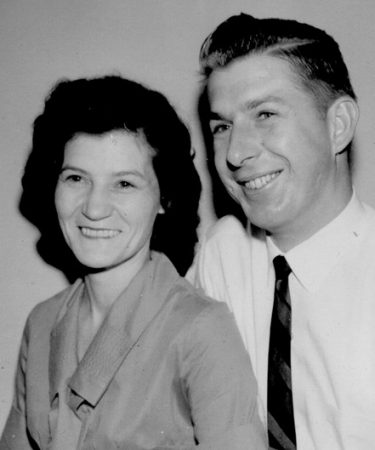
Pearl and Floyd Franks

When the feast was ready, the table groaned under plates of cheese omelets, crispy bacon, sausage, and steaming biscuits nestled in a bread basket. My brother and I, still in pajamas and robes, stumbled in, bleary-eyed but eager. We’d bow our heads to thank the Lord, then serving plates would fly as the food disappeared. Homemade apple butter, a sweet Southern staple, was slathered generously on those biscuits. As we ate, we talked—about the day ahead, weekend plans, or some milestone from the week. Those breakfasts were more than meals; they were where love and laughter solidified our family’s bond.

Why, in my dream, was I the one cooking, Spam sneaking into the breakfast lineup? Perhaps I was stepping into my parents’ roles, honoring the care they poured into every dish. My mother’s been gone 19 years, but in that dream, we shared a moment across the veil, her presence as real as the sizzle in the pan. When I woke, I got up, fried some bacon, and made a sandwich—a simple act I hadn’t done in years, but one that felt like a quiet tribute.

As this next Saturday rolls around, gather your family for a meal or a memory, whether it’s bacon and biscuits or even Spam. Those moments, steeped in love, might linger in your heart long beyond the years.

Shared Stages and a Life’s Calling

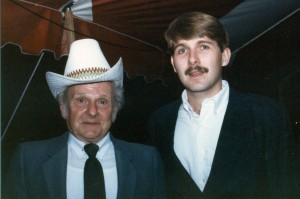
Ralph Stanley and Randall Franks in 1988.

In the summer of 1985, I stood under the bright lights of Nashville’s Fairgrounds Speedway, my mandolin ringing out as I harmonized with bluegrass legends Ralph Stanley, Wilma Lee Cooper, and Bill Monroe on “I Saw the Light.” The roar of 12,000 fans filled the air, and in that moment, I felt a fire ignite in my soul. That year, through shared stages with mentors and massive crowds, I discovered my calling—not just to play music, but to uplift and connect with audiences for a lifetime.

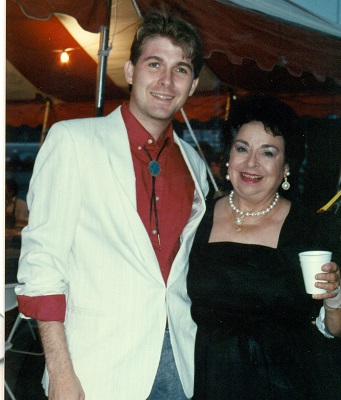
Randall Franks and Wilma Lee Cooper

The week began at the Country Music Association’s Fan Fair, a vibrant celebration drawing 25,000 country music lovers to the Nashville Fairgrounds Speedway. On that Monday night, my band, the Peachtree Pickers, took the stage for the Grand Ole Opry’s Early Bird Bluegrass Show, marking our second Opry appearance. We shared the spotlight with giants like Bill Monroe and the Blue Grass Boys, Ralph Stanley and the Clinch Mountain Boys, and Wilma Lee Cooper. Though the exact songs we played have faded from memory, the thrill of our set—our teenage energy blending with bluegrass tradition—remains vivid.

The highlight came when I joined Stanley, Cooper, and Monroe to sing “I Saw the Light.” As we sang, my mandolin chops keeping time, I felt both awe and belonging. These legends, whose records I’d worn out as a kid, were now my peers for a fleeting moment. My hands trembled matching Monroe’s rhythm, but their warm smiles steadied me, teaching me that true artistry lies in serving the music and the audience. After the show, while my young bandmates headed home, I stayed to sign autographs and visit with fans throughout Fan Fair week, soaking in the connection that would fuel my career.

Weeks later, I traded my mandolin for a fiddle and faced an even bigger stage at the National Folk Festival in Ohio’s Cuyahoga Valley National Park. As the fiddler for Doodle and the Golden River Grass, I represented Georgia’s fiddle band tradition, walking in the footsteps of Gid Tanner and Clayton McMichen.

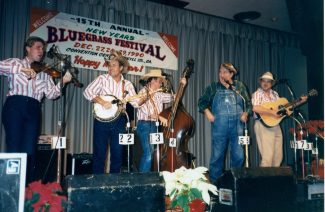
Randall with the Doodle and the Golden River Grass in 1990.

Shuttles whisked us backstage, where a funk band’s deafening set made tuning my fiddle a challenge. With 60,000 people waiting and a live radio broadcast looming, I battled nerves to tune my fiddle’s notes. When the emcee introduced us, I launched into “Fire on the Mountain,” giving it everything I had. Doodle Thrower, a master showman, worked the crowd like a conductor, guiding them from elation to sadness with a twist of his harmonica. His jokes sparked ripples of laughter that washed over the crowd like waves. I’d never felt the impact of an audience’s applause like that before or since—it flowed through my fiddle, confirming this was where I belonged.

Nashville taught me the power of mentorship; Ohio showed me the magic of moving a crowd. The lessons I absorbed those days reshaped my life’s path and led me to where I am today. Moments can make us—don’t miss yours. To hear more about my time with Ralph Stanley, watch the mini-documentary Bluegrass Legends: Ralph Stanley & Randall Franks An Interview 

Why Do Our Dreams Return Us to Familiar Places?

Why do our dreams so often transport us to familiar settings—our childhood homes, old schoolyards, or long-forgotten rooms? For me, these recurring landscapes are no coincidence. I believe our minds seek comfort in the known, anchoring us in spaces where we once felt safe to help us rest, reflect, or even receive deeper insights. My dreams, in particular, consistently return me to my childhood home, a place of warmth and security that continues to shape my sleep and my soul.

In these dreams, I’m back in that modest house, creaky wooden floorboards underfoot, the faint scent of my mother’s L’Origan perfume lingering in the air. The faded diamond-patterned wallpaper in the hall is just as I remember, though the scenes often defy time. I might be my current age, chatting with my parents about challenges they never witnessed, or joined by an old friend I’ve lost touch with, as I was just last night. Nothing extraordinary happens—just a visit, a conversation—but I awaken wondering what it meant. Was that dream a quiet reassurance that my friend, wherever they are, is okay? These familiar surroundings feel like a canvas where my mind paints comfort and connection, even when reality offers none.

This sense of comfort leads me to reflect on why my mind chooses this setting. I’ve read that our brains often choose familiar settings in dreams to process emotions in a safe, recognizable context—a theory that feels true to my experience. My childhood home isn’t just a backdrop; it’s a sanctuary where I feel grounded, whether I’m reliving memories or imagining new moments. It’s not my favorite vacation spot or a fantastical realm—it’s the place where I felt loved, allowing me to rest deeply or confront life’s uncertainties with clarity.

In my youth, dreams of home felt like more than nostalgia. As I pursued a career in entertainment, I believed God used these familiar rooms to offer guidance, showing me paths I might have avoided—opportunities my fears could have blocked or people I wouldn’t have met. These dreams were guideposts, blending divine insight with the study and practice of my waking life. Another dream left me awestruck: I saw a portly, gray-haired black woman, unknown to me, tenderly caring for a young boy. She addressed me by name, offering gentle advice with a warm smile, as if I were one of her charges. A man’s voice called her Grace. When I shared this with my mother, she was stunned. Grace, who died before I was born, had generously given her time caring for my older brother when my mother was a struggling single working mom, long before my time. I’d never heard her name, yet there she was, a guardian angel in my dream. My mother’s eyes lit up, and she said, “You have a wonderful guardian angel watching over you.” Though I didn’t always follow such guidance perfectly, these dreams shaped my path, placing me where I could grow and serve.

But dreams of familiar places aren’t always serene. Nightmares from my youth—tossing and turning in my twin maple bed—still linger in my psyche, like one so vivid I woke bouncing in fear, running to my parents for comfort in the wee hours. These moments, though rare, show that even in distress, our minds cling to familiar settings to confront hidden fears or traumas. For me, such nightmares are exceptions, and my long-ago home remains a refuge where sleep brings solace.

So why do our dreams return us to familiar places? I believe they are the heart’s safe harbor, where we rest, reflect, and sometimes glimpse deeper truths. Whether it’s my childhood home, your old classroom, or another’s quiet street, these settings remind us that even in sleep, we seek comfort to face life’s uncertainties. For me, these dreams are a gift—a blend of memory, faith, and hope that guides me, one familiar place at a time.