Posts

Giving What Really Matters

As a five-year-old, I pressed my nose against the Western Auto window and fell in love. There it sat—the shiniest red Radio Flyer wagon I’d ever seen. Its chrome hubcaps practically winked at me, whispering, “Take me home.” At least that’s what my little-kid brain heard.

Christmas was simpler then. My friends and I came from similar working-class homes. If things were going well, we each got one “big” gift and a couple of practical ones—tube socks, a flannel shirt, maybe a dress shirt for church.

As years passed, the dream in the window changed: a Red Ryder BB gun, a Matchbox racetrack, model airplanes and ships, then a bicycle. Eventually the dreams outgrew my parents’ budget. I saved lawn-mowing money for a candy-red English racer while they supplied smaller gifts that matched whatever I’d bought myself.

Once I was old enough to earn real money and stopped making the lopsided clay ashtrays, I settled into my own gift-giving routine. For Dad: handkerchiefs and Old Spice aftershave. For Mom: L’origan perfume, (she never changed brands), a box of chocolate-covered cherries, and one unique item I’d hunted for all year.

Yet our tree was never buried in presents—two or three gifts each, that was it. What we lacked in quantity, we made up for in generosity toward others. Mom baked for neighbors. We filled food boxes for families in need. Dad spent evenings in the garage restoring donated toys for children who might otherwise wake up to nothing.

That’s what my parents taught me Christmas is really about: using whatever God has given you to lift someone else up.

For me, those gifts turned out to be music and acting. Every December I sang at church or performed at nursing homes, watching eyes light up brighter than any string of tree lights.

Christmas doesn’t require big price tags. Sometimes the best giving is simply sharing whatever talent, time, or kindness you have to offer.

This season, I hope you discover the deeper joy that comes from giving quality instead of quantity—and from meeting needs rather than feeding wants.

May the bliss of Christmas find you in the giving.

Track: The Dog Who Listened

I stepped out the back door and plopped down on the top step. Our back stoop had just three concrete steps leading down to the sidewalk, which ran along the rear of the house to the gate.

There, my faithful, hairy companion Track arrived and rested his head in my lap. He was a cross between a beagle and a peekapoo and looked like the movie dog Benji, but with darker hair.

As a child, I was allergic to animals, so I wasn’t always the loving master Track deserved. My father made up for my shortcomings, I think. Still, there were many times when my childhood world seemed to be crashing down around me, and Track would lay his head in my lap for a heart-to-heart.

I often paint with the brush of idealism when I write—because we all prefer the polished version of the past. But there were times when the gleam didn’t reflect well on us.

Life isn’t easy, and the daily grind can wear us down. Parents sometimes share intense “fellowship” with each other. Sometime kids push the envelope saying or doing things they should not. In my experience, though, that rarely ended well for the child. A meeting of the minds often came with the crisp whir of my father’s belt slipping through its loops—a sound every kid recognized as the line being crossed. We’d bolt for cover: the bedroom, the den, or—on occasion—behind my mother’s kitchen chair. Sometimes she’d come to our defense, but mostly the two tall grown-ups were united on discipline. For me, the licking wasn’t pleasant, but the pain was transitory. The lesson lingers decades later.

When the stress peaked—whether from my parents’ arguments, my own misbehavior, or a friend’s betrayal—Track was always there. His brown eyes gazed up into mine, listening to my complaints as tears ran down my cheeks.

He listened. He consoled. In some way, I know he understood my hurt. Compassion knows no bounds between humans and our furry friends. For me, Track was a constant. Our playtime was limited, but he entertained himself with fierce intensity in his enclosed backyard domain. He’d bark insistently at any passersby who dared approach the fence, claiming his territory. The garbage men endured it every Tuesday as they grabbed our two metal cans, hauled them to the truck, dumped them, and returned them. Service was personal back then. Track would bark at our cans, follow them to the truck, then race to the neighbor’s in-ground can to bark some more. I assume he relished the weekly ritual.

For all his bravado, Track wouldn’t hurt a fly or snap at a person. I recall one adventure when we harnessed him and the neighborhood dogs to wagons with wheels and raced them down the street. Oscar, a huge dog, always won—and if he broke free, we’d chase him endlessly. Track excelled at pursuit, shooting down the block like a bullet from a gun. I’d usually find him at Oscar’s fence, the two running back and forth, one on each side. He did the same with Herman, the elderly next-door dog who preferred not to run.

Except for a few months while I earned my animal husbandry merit badge, Track led a solitary life, broken only by brief visits from neighbor dogs. During that time, we brought home Lassie from Raymond, the janitor at my elementary school. She and Track had seven puppies, which we placed with families—including some back with Raymond, who hunted with them. Lassie eventually went to another home, too.

Track was my confessor, my friend, and my steadfast companion through childhood.

When he passed, I built him a small coffin and laid him to rest between a peach tree and a crab apple tree—his favorite spot. It was a sad day for my dad and me as we said goodbye. I haven’t had a pet since, and I don’t plan to.

Lessons from a Lost Pocketknife

When I was a small boy, like many up-and-coming business folks, my parents sought a getaway near the city—a haven from the hustle and bustle, but not too far for quick trips filled with camping, fishing, and swimming.

For my older brother and me, this sounded wonderful. He’d already experienced more rustic life on the family farm in the mountains before we relocated, but that spot was too distant for weekend escapes. My folks eyed two burgeoning options outside Atlanta: Lake Lanier in Hall County and Lake Capri in Rockdale County. They bought a lot at Lake Capri because it was closer to home. At the time, the lakes were neck-and-neck as getaways, but in hindsight, Lanier would have been the better choice.

Still, we became Lake Capri owners, and our treks began. We’d load the fishing gear, lawn chairs, and Coleman stove into the camper on our pickup truck. The cooler brimmed with potato salad, cold cuts, bread, ketchup, mustard, and Mom’s chocolate-frosted cake—plus breakfast items for overnights. Off we’d go.

During grass-mowing season, we’d add a push mower and gas can. That was an unforeseen chore my brother and I hadn’t anticipated: more acreage meant more legwork for us. It was worth it, though. After a couple of hours mowing, we’d switch to swimming trunks for a dip or grab rods for bank fishing.

There was always a peacefulness about sitting on the lake shore as puffy white clouds drifted across the blue sky. All you could hear were crickets chirping in the bait box, awaiting their dunking in hopes of dinner. Of course, we had plenty of red wigglers ready for a bath, too. While my older brothers became skilled fishermen, I never inherited the gene. I tried, but sometimes I felt like the jinx from The Andy Griffith Show who spoiled every catch.

I remember one trip when I’d gotten my first pocketknife as a gift. I was so proud—it was a tool, a rite of passage marking my progress from boyhood to manhood, like getting a BB gun and later a .22 rifle. I carried it everywhere, even to school back then. My swimming trunks had pockets, so in went the knife without a thought.

We fished first that day. I’d cast my line and set down my small rod, distracted by something. Suddenly, a fish big enough to yank it into the water struck. I chased after it, blending fishing and swimming in one frantic splash. Waist-deep (which wasn’t far for my size), I grabbed the rod and tried to set the hook, but the fish had skedaddled with my bait.

The sad part: in my enthusiasm, my pocketknife slipped out and sank to the lake bed. Heartbroken, I went back in and searched frantically, but to no avail.

My parents consoled me, but it stung. In my mind, I’d stepped backward on the path to manhood by losing that possession. I was still the same boy, of course, and they soon replaced the knife—perhaps I guarded it better because of the lesson. That mishap, and those family times, left a sharp memory I’ve cut my teeth on all these years later. Are you making lasting memories with your family? Maybe today is a good time to start.

Candor—Blessing, Curse, or Both?

We’ve all been there: someone you care about asks for your honest opinion, and suddenly you’re standing at a crossroads. Do you tell the unfiltered truth or soften it to spare their feelings? Maybe it’s a loved one asking, “Does this dress make me look fat?” Or perhaps it’s your boss, brimming with enthusiasm, seeking your thoughts on their latest “game-changing” idea. What do you say when the truth might sting—or worse, land you in hot water?

I learned this lesson early, at the tender age of four, in a moment that still makes me chuckle (and cringe). My mother and her girlfriends had stumbled into a side hustle selling wigs—a practical solution for busy mothers who couldn’t always make it to the beauty parlor. With budgets tight and schedules packed, a wig was a godsend: pluck it off a Styrofoam head, slip it on, and voilà—you were ready to face the world, looking as glamorous as Dolly Parton, who helped make wigs a cultural phenomenon. My mom owned three, each with a slightly different style and length, allowing her to switch up her look with ease. As a young boy, I never thought to question how she looked. My answer was always the same: “You look pretty, Mommy.”

But one hectic week, that innocence got me into trouble. My mother was juggling her usual duties at home while volunteering extra hours at my kindergarten, housed in the basement of our local Presbyterian church. She was coordinating a parents’ gathering, a chance to connect with other moms and dads over punch and cookies. That evening, she donned her best wig—a voluminous, chestnut-brown number—and a vibrant polyester dress she’d picked up from Rich’s department store. We piled into our blue Chevy Malibu and rolled down the road to the church, where the event was already in full swing.

As we mingled, Mrs. Moore, my kindergarten teacher, spotted my mom and gushed, “Mrs. Franks, I don’t know how you do it. Your hair looks fantastic!” I beamed with pride, eager to share in the praise for my mom’s effortless style. Without a second thought, I piped up, loud enough for the whole room to hear, “Mom’s wearing a wig!”

The room fell silent. I didn’t know I’d just spilled a trade secret. To me, it was just a fact, as innocent as saying the sky was blue. But the looks on the adults’ faces told a different story. My mother’s smile tightened, and I could feel the heat of her embarrassment. I’d landed myself squarely in the doghouse, and no amount of four-year-old charm could dig me out.

There was, however, an unexpected silver lining. My blurted truth sparked curiosity among the other parents, and soon, my mom and her friends sold a few more wigs as a result. But that didn’t erase the lesson etched into my young mind: candor—raw, unfiltered honesty—can be a double-edged sword. It’s a trait we’re taught to value, yet without a touch of tact, it can wound as easily as it enlightens.

Candor is like a wild horse: powerful and admirable, but it needs a bridle to keep it from trampling feelings. We live in a world that often demands honesty but recoils when it’s too blunt. Think about the workplace, where a colleague’s “brilliant” idea might be a logistical nightmare. Do you risk derailing their enthusiasm—or your career—by pointing out the flaws? Or consider the delicate dance of personal relationships, where a poorly timed truth can turn a simple question into a minefield. “Honey, does this dress make me look fat?” isn’t just a question about fashion; it’s a test of diplomacy, trust, and love.

Navigating these moments requires finesse, a balance of truth and kindness. It’s about being honest without being brutal, offering feedback that respects the person even as it addresses the issue. For example, instead of saying, “That idea won’t work,” you might say, “I love your creativity—let’s brainstorm how to make it even stronger by addressing X.” Or, to the dress question, a gentle, “You look great, but I think the other one highlights your style even more.”

My wig-blurting moment taught me that honesty, while noble, needs a filter. As adults, we’re not so different from that four-year-old version of me—eager to speak our truth but still learning when to hold back. The next time you’re faced with a question that demands candor, take a breath. Weigh the moment. Find the words that inform without injuring, that build up rather than tear down. With a little polish, you can stay true to yourself—and stay out of the doghouse.


A breakfast that lingers

As Mother’s Day morning drew near, I dreamed I stood over the stove in my childhood kitchen, frying pan in hand, setting it on the glowing red burner. Bacon sizzled, filling the air with its familiar aroma, while eggs waited in a bowl for a cheese omelet. Slices of Spam—a lunch or dinner staple from my youth—sat ready, perhaps a quirky twist of memory blending meals across time. I rarely eat breakfast, usually skipping it, but in my dream, I was stacking tasks like a seasoned cook: frying bacon, prepping Spam, whisking eggs. My mother sat in her favorite chair by the kitchen table, watching me work, our conversation as warm as the stove. I didn’t see biscuits, but I imagined them baking just inside the brown oven door below.

That vivid dream stirred memories of Saturday mornings long ago, when the smell of bacon frying would coax me from sleep. Our small kitchen buzzed with activity as my parents worked side by side. Dad, the omelet master, grated cheese and cracked eggs, while Mom patted out fresh biscuits, her hands dusted with flour. Bacon and sausage crackled in the skillet, and the oven warmed with the promise of golden biscuits. That cramped space never bothered them—they seemed to cherish it, perhaps recalling leaner times with even less.

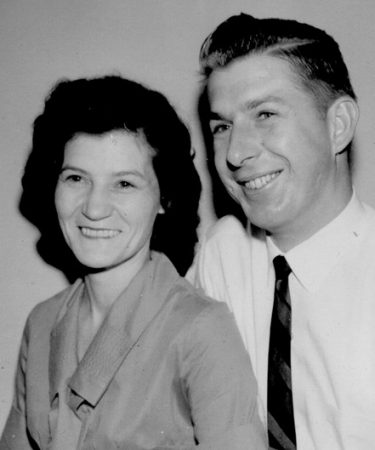
Pearl and Floyd Franks

When the feast was ready, the table groaned under plates of cheese omelets, crispy bacon, sausage, and steaming biscuits nestled in a bread basket. My brother and I, still in pajamas and robes, stumbled in, bleary-eyed but eager. We’d bow our heads to thank the Lord, then serving plates would fly as the food disappeared. Homemade apple butter, a sweet Southern staple, was slathered generously on those biscuits. As we ate, we talked—about the day ahead, weekend plans, or some milestone from the week. Those breakfasts were more than meals; they were where love and laughter solidified our family’s bond.

Why, in my dream, was I the one cooking, Spam sneaking into the breakfast lineup? Perhaps I was stepping into my parents’ roles, honoring the care they poured into every dish. My mother’s been gone 19 years, but in that dream, we shared a moment across the veil, her presence as real as the sizzle in the pan. When I woke, I got up, fried some bacon, and made a sandwich—a simple act I hadn’t done in years, but one that felt like a quiet tribute.

As this next Saturday rolls around, gather your family for a meal or a memory, whether it’s bacon and biscuits or even Spam. Those moments, steeped in love, might linger in your heart long beyond the years.

I thought I had lost my marbles

I was going through some boxes in the attic the other day and came across something that spurred some fond memories.

It was an old cotton tobacco bag with a tie string. These were designed to keep the tobacco fresh and protected but instead inside of it was my collection of marbles that were an amazing part of my youth.

A marble is a small, spherical object often made from glass, clay, steel, plastic, or agate. Typically those are around 13 mm (1⁄2 in) in diameter. These colorful toys can be used for various games, such as marble runs or races, or created as a form of art.

I don’t know if children still play marbles but for me it was an amazing past time.

A couple of friends would draw a circle on the ground in the dirt, drop marbles into the circle and then we would take turns shooting to knock the marbles out of the circle. Of course, the winner got to keep the other player’s marbles. So, our collection could grow or reduce depending upon our skill with our favorite shooter and the skill and strength of our thumb flick.

I am amazed that this childhood collection actually survived all these years. I was not the best player in the world, so I must have become tired with playing and stored away my marbles. I sort of figured I had lost my marbles years ago. Most people would probably say something similarly.

I don’t know if that little boy could have imagined who the adult man would become.

He certainly could not have imagined the crooks and turns of love and life in general. I have many friends who have remained throughout my life, others who fell by the wayside. I have fell in love several times but never successfully. The process never took as it was. That was definitely not how young Randall envisioned his future. But God had another plan.

Professional opportunities have taken me around the U.S., Canada and Mexico entertaining folks from all types of stages and placed me of TV and in films for audiences around the world. Those are also things little Randall could never have seen coming. But I will say, I was blessed by each and every moment thus far and look forward to anything He allows ahead.

Playing games was a vital part of every childhood day. Those kept us physically active, mentally engaged and strategically learning and growing. As adults, we need the same type of activities to make each day better. We all work hard to make a living; so a little time each day doing something for recreation stimulating our mind and/or our body is productive for us all.

I fondly miss those days when I looked forward to the sun coming up and I hit the door running to fill the day with all types of adventures and games. Finding people to play with and creating game to play was all that was on my mind. I guess as adults, we see our hobbies in this way – fishing, hunting, sports, racing, motorcycling, bicycling and others. So, in a way we have days from time to time we rush out of the house looking forward to doing these things with our friends and/or families.

As I stared into the beautiful colors of those marbles rolling them around in my hand, I could see myself on my knees shooting with ease at the marbles in front of me within the circle. I could hear the clicking sounds they made as they hit. I could feel my bag heavier after winning.

Marbles may be bygone for me, and I am sure there are some who would say I lost them long ago, but I am sure glad I ran across them at least for a bit before returning them to their box once again for safe keeping until I find them again.

Where are we headed?

I sat in the back of the blue 1964 Chevy Malibu with my legs dangling of the blue seats with my feet moving to the beat of the Buck Owens coming across the AM radio.

My father Floyd was driving and my mother Pearl in the passenger seat. The back seat was my domain, the only thing back there was my pillow and a few of my favorite toys, a couple of books. There was a small box with plastic army men, and a few of my Matchbox cars. Unlike today, I could move around as I wanted on the seat or into the floorboard. If I wanted to lay down and take a nap, I could. That was probably how my folks liked me best on those long trips. Because I am sure I wore them out with my impatience asking “Where are we headed?”

It’s not like they decided to go somewhere else while we were driving, but I just wanted up to date information. Of course, back then we didn’t have those new fangled things that talk to us telling us where to turn. We had those big map books, or fold out maps on every state that we went through.

Of course, by the time I came along, the interstate system was solidly in place around the country, so much of the time was spent on those types of roads between places.

And prior to the internet and widespread franchising, every little community we stopped in had its own feel and identity – restaurants, stores, and events. Of course, my mom always had a trunk full of homemade food on ice and we stopped along our paths to eat.

Whenever we hit the road for a vacation, we always had mysteries and new things to find and experience. Even if it seemed odd or hokey, there was great things we were able to see among those too.

I loved those trips with my folks. We always managed to talk to each other. My folks would wake me in case they thought I might miss something, probably not always wise, because it probably broke the silence they were enjoying. But they saw trips as an educational opportunity for me and even for them.

As I grew and my interest in history became primary, those types of destinations were added along the way. I was able to share my excitement and learning with about the topics and locations with them. They could also do the same with me.

I wouldn’t trade those road trips, short or long, for anything. I had my folks sometimes for endless hours right at my fingertips together. We cherished those moments.

When I was very small, especially during winter travel, I loved to crawl up into the floorboard at my mother’s feet and sleep on those trips.

I know travel is now different for families today than they were for us. But I encourage you to find those opportunities to make such adventures come alive for your family. And you know what, you don’t have to spend a mint to make it a memory.

May I ride in your little red wagon

I slowly filled in white letters on the side of my red Radio Flyer. The restoration project of the wagon which had pulled around neighborhood friends, dogs and all kinds of childhood toys along Warwick Circle and the surrounding area was now complete.

Why? You may ask. Well, when I was about six, that bright red wagon was sitting with a bow on it under the Christmas tree. It had come from the local hardware store and was something I am sure I had asked for, although I don’t remember that aspect of history.

It became a constant companion through my childhood years, pulled behind me by hand or tied to the back of bicycles, ridden down hills, and always signified happier childhood adventures.

I managed to hold onto it through the years and I realized that it would make a great platform for the small Christmas tree that I set up.

So, I decided to restore it back to its original condition. I brushed away any rust that might have popped up through the years, and then gave it a nice coat of red, black and touched up the white lettering and wheels. I shined up the tires and got those looking sharp.

Sometimes, we just need to do something that brings a sense of accomplishment to our inner child. Revitalizing a piece of our history in a way it might again be put to use was such a blessing to me.

In many respects, I have become the custodian of many family heirlooms through the years. Appliances like pedal sewing machines, furniture passed down – bedroom, dressers, oil lamps, walking canes, photos, and other items.

The care of these, so they might be passed down to another generation, is an important aspect of who I am and my overall tasks in my life. I was entrusted in these efforts by loved ones no longer here. Will they know what happened to them. I doubt if they are keeping an eye on me or them from the other side, but its still my charge.

I have managed to bring several of these back from poor condition in hopes these will be valued by whichever relative ultimately receives each item.

No matter how long we may hope we walk this earth, we are not promised tomorrow. Only today is within our grasp, and our hold on it is totally in the purview of God.

We are to leave things better than we found them. For me, that is my constant hope. I try to make things entrusted to me better than they were.

I couldn’t make my childhood wagon new again, but I could make it look a close as possible and find a use that would give me joy in seeing it annually when I pull it out for Christmas and fill it with decorations that remind me of the happy family times.

So, for me the adventure of restoration, made my inner child happy and once a year it brings a smile to adult me as it enhances the joy of Christmas. Find something to restore in your life that will make you happy.

I hope the mention of Christmas has brought a bit of cool thought into your summer. We could use a bit less heat where I live!

A refuge under the covers

When I was a little boy, my brother and I shared a room with two maple single beds, a maple night stand, and a maple dresser with six drawers – three on each side with a large mirror spanning its width. The beds had pineapple finials on their posts. My older brother left me behind in the room early in my life after he graduated high school headed off to the Navy. There was 15 years between us. The room was lonely once he was gone. He often had friends over that allowed me to be the annoying little brother! I reveled in all the mischief I was able to cause as a toddler.

That room became like a cavern to me. In the dark, there were definitely monsters under both beds, in the closet and walking down the hallway leading to the room. I could hear every creak and pop. Any little thing would have the handmade quilt pulled so high over my head, it was doubtful I would ever dig myself back out again.

When the fears of nightmares were too hard to bear, my parent’s bed was a refuge, and off I would run up the hall, open the door, and jump in between them in their cedar bed. After they calmed me, I would soon settle in warm and snug between them.

As I grew, my bed became also a sick bed, as my tenuous health caused me to take extended stays there. The maple night stand became a regular place for bottles of medicine, damp wash rags would remove the vanish over time as they would hang there between my fevers.

In my childhood, the room had none of those things children have today. There was only one TV in the house in the living room. Only what could fill my imagination with the toys from my closet were what I had to keep me occupied in the healthy times. I also had a candy red tricycle which allowed me some freedom in the back yard and, of course, like many I had my own cowboy outfit, with a cap pistol, so I could chase after the bad guys.

That room was my world as a kid. I knew every flaw, every loose board, and where I could hide from company if they came. Despite being alone, I filled it with lots of imagination.

As the years passed, I remained there until I was in my teens and the den was converted into a more adult bedroom for me and the childhood bedroom became a guest room.

Years later, we decided to sell the suite and it moved along to a family that had a set of twin girls who would then call it their own. I hoped they found as many happy hours there as I did and experienced a few more joint memories as siblings. The bedroom suite was second hand to my brother and I, so I imagine it has moved on a time or two more since then.

While furniture does not carry memories with it, the pieces certainly can leave a memory legacy within each of us. Today, I still sleep in that cedar bed I once jumped in as a toddler. A few feet away are the dresser drawers which served as my bed as an infant. I imagine, if it is the Lord’s will these items will be with me the rest of my journey and then will pass along in the family.

The smell of flowers upon the heart

The sweet smell of flowers emanated on the breeze as I ran through the backyard trail. For me, as a small boy, it seemed immense as the rhododendrons towered above me.
It was like an enchanted garden that you could imagine catching the Irish little people scurry out of your sight and the fairies to be dancing in the air about you.
It was a backyard domain of vibrant red, purple, pink, white, orange and yellow colors in every shade created by long serving forestry employee Baxter Reed who created the sights and smells for his loving wife Hazel.
Baxter and Hazel Reed were my childhood neighbors. They were of my grandparents’ generation and themselves had no children. But in their own way, they had many grandchildren – those who made up our little neighborhood.
As we played upon the streets or across the yards, they were there to smile and cheer us along. There were often cups of lemonade nearby and occasionally a cookie to boost our energy. Hazel’s love emanated through many of us.
I was able to come to know Baxter some as I assisted him with a few chores around the yard before his Parkinson’s advanced to where he was less active.
The couple was originally from Oregon and Baxter had retired from the forestry service. I am not sure what had brought them to Atlanta and our neighborhood. I guess I never asked, or if it was said, it was lost in the annals of my youthful inquisitiveness.
But from him I learned that in order to create a beautiful environment, outside of nature’s normal beauty, it took dedication and care. That is what he gave to the space he created for Hazel and him to enjoy.
When I was big enough, I took on mowing yards to earn money. The one yard that I really did not want to mow was the Reeds. Mr. Reed had cultivated the only Zoysia front yard in the neighborhood. It was thick and difficult to push the mower through. But in time, I was asked and could not refuse Hazel’s request.
One of Hazel’s pastimes was painting flowers on china, and she was very good at this hobby. I was blessed as a boy to get a few of her creations and have cherished them through the years. I recently passed those along for someone else to continue in that enjoyment.
In life, often we are not provided what other might see as the ideal situation. We may not have family or close friends with which to share our day-to-day. There may be no children who will carry on our legacy. Our health may not be the best it can be. We may face problems of our own making or thrust upon us by others.
No matter what is in the hand we are dealt in the game of life, it is our job to play it. To make the very best of the situation and along the way to strive to make our world a better place.
The Christmas and New Year’s holiday season is a time for many of loneliness. In some cases, people are outgoing and can fill the time with friends or activities that mask this until the season is passed. But others are mired in a stillness that prevents them from seeking the support of others.
You have a chance to make the lives of those around you better every day of the year. This is a lesson I learned from Hazel and from Baxter, you do your best to uplift, encourage and persevere no matter your circumstances and while doing that you make your life, your days, and your circle of engagement a happier and more loving place to be.
Create a memory that lasts far beyond you. Thank you, Hazel and Baxter, gone from us now for decades, but still in the memory and in the heart of one of those little neighborhood boys.